Pros of buying a bungalow include easier access for older or disabled people, low maintenance, privacy and potential to change layout and extend. But cons include a lack of bungalows for sale in your area, many bungalows may need updating, high prices, “bungalow legs” and potential to feel cramped.
Should I buy a bungalow?
Here are some of the reasons why buying a bungalow may be right for you.
Who a bungalow suits
There are a number of types of buyers who typically suit buying a bungalow including:
Downsizers: Homeowners looking to move from a large family home to a property that’s easier to manage often favour bungalows. Read our guide Downsizing your house: the pros and cons.
People planning ahead (future-proofing): Buyers in their 60s or early retirement often choose a bungalow as a “forever home” because it eliminates future problems with stairs.
Anyone with mobility issues: Whether due to disability, injury, or reduced mobility, a step-free layout can make a huge difference to safety, comfort and independence.
Small families and couples: Young families often like the lack of stairs, and the practicality of having children’s rooms close by. Plus, bungalows are often on large plots, leaving the potential for extending as a family grows.
Retirees: Bungalows tend to be quieter, more private and easier to maintain which are all big plus points for many retired homeowners.
There are a number of benefits that often come with buying a bungalow, including:
Low maintenance There are fewer structural elements (no stairs or second storey etc) which can mean simpler upkeep, fewer repairs and lower long-term maintenance costs.
Easy access indoors and out, which is a particular benefit for people with reduced mobility who may have a walking aid or wheelchair.
Safer for young children and older adults as there are no stairs to fall down. And as we age, stairs can become trickier.
More privacy: Many bungalows sit on wider plots and have larger gardens.
Flexible layout: With all rooms on one level, it’s easier to reconfigure spaces, extend outwards, or adapt the home later.
Reasons some buyers avoid buying a bungalow
Despite their advantages, bungalows aren’t for everyone. Reasons some buyers steer clear of buying a bungalow include:
Limited supply: There is a shortage of bungalows in many parts of the UK, which means you may struggle to find the right property in the area where you want to buy. Plus, this adds pressure on prices.
Layout: Some people simply prefer upstairs bedrooms for privacy or noise separation.
Bungalow legs. A study of 6,000 older people in Japan, published in the journal BMC Geriatrics, found that having stairs in the home helped hold back age-related physical decline. Stairs challenge your legs in different ways to normal walking.
Lack of space: A similarly priced two-storey home often offers more square footage. You may feel you’re not getting enough space for your money with a bungalow.
You prefer new builds: If you want a new build property, you may struggle to find a bungalow in your preferred area given how few new build bungalows are built each year.
Keep your eye out: Tell friends, family and neighbours that you’re interested in buying a bungalow. They may be able to give you early warning of anyone they know living in bungalows who are planning to sell soon.
Consider unmodernised homes: Many bungalows are dated but easy to update or extend. A tired property is often the best route in – and the best value.
Think beyond pure single-storey: Chalet and dormer homes can work just as well, and often come with potential to reconfigure into the layout you want.
Be ready to move fast: Have your mortgage in principle (if you need a mortgage), solicitor and budget lined up. Good bungalows can go in days.
Look for future-proofing potential: Level access, parking on the doorstep and scope for an accessible bathroom will all add long-term value.
Check the construction: Some older bungalows use non-standard materials. Always get a survey and check you can get a mortgage (if you need one) before committing.
What to look for when buying a bungalow
Bungalows vary enormously in layout, age, build quality and potential. So if you’re considering buying a bungalow, it’s important to check carefully whether the property you’re looking at is right for you. Use this checklist to help you.
Does the layout work?
Consider how well the floorplan flows. With everything on one level, a bad layout can make the bungalow feel cramped.
Where are the bedrooms? Check there is enough separation between living areas and sleeping areas for privacy.
What about storage? Many bungalows lack loft storage if the loft has been converted, so built-in storage becomes more important.
Plan ahead: Does the layout allow for easy accessibility later, such as wide corridors for wheelchairs and room for ramps?
Plot size and privacy
Walk around the garden to see if neighbours can easily overlook windows, patios or bedrooms.
Large plots are great for future extension potential but also mean more garden maintenance.
Potential for future alterations
One big advantage of buying a bungalow is how easy they can be to adapt or extend. Even if you don’t plan to do this yourself, buying a property with potential to extend may make it easier to sell in the future.
Could you extend to the rear or side of the property?
Consider how easily internal walls can be moved if you’d like to change the layout.
Roof condition
The roof condition is one of the biggest cost considerations with bungalows because it covers a larger surface area than a two-storey house. Replacing it can be expensive.
Look for:
Missing, slipped or broken tiles
Sagging rooflines or signs of structural movement
Patch repairs or mismatched tiles
Condition of fascias, soffits and guttering.
However, while you may be able to spot some problems, you’ll need a survey to get a detailed report.
Damp and ventilation issues
Bungalows can be more prone to damp. When you’re considering buying a bungalow you should check for:
Mould, musty smells, peeling paint or condensation around windows.
Adequate extractor fans in kitchens and bathrooms.
Damp staining around chimneys, dormers or flat-roofed extensions.
However, we always recommend getting a survey when buying a bungalow (or a house). This will highlight potential problems with the condition of the property and may suggest further investigations.
Extensions, loft conversions and dormers
Many bungalows have been extended over the years. However, if it has been extended poorly, this could store up expensive problems to fix.
If you’re buying a bungalow that has been extended, ask to see evidence that the seller obtained the proper consents and approvals for the building work such as copies of planning permissions, Building Regulations approvals and completion certificates.
Look for any inconsistent floor levels, thin partition walls or DIY electrics.
Check for any cracks, damp patches or poor insulation around any extensions.
Your surveyor should check this during the survey but it’s advisable to flag with your surveyor in advance that this is an area of potential concern.
Energy efficiency
Because of their wide roof span and exposed walls, bungalows can be more expensive to heat unless well insulated.
Most people buying a bungalow will have experience of buying property – but don’t let this put you off booking a survey to check the condition of the property before you buy.
Buying a bungalow comes with some potential downsides you’ll need to consider. These are:
Higher price per square foot. Bungalows often cost more per square foot than houses, due to the larger plot required to accommodate their single-storey layout and shortage of supply.
Limited living space: If you’re used to living in a large family home, a bungalow may feel smaller by comparison.
Reduced privacy in urban areas: Bungalows in urban or suburban settings may have windows and living areas overlooked by neighbouring properties given their single-storey design.
Limited choice: Bungalows make up a small percentage of the UK housing stock with fewer being built in recent years. As a result, buyers may face limited options, especially in desirable areas.
In more detail, Ward v Paterson [1929] 2 Ch 396 defines a bungalow as a “building of which the walls, with the exception of any gables, are no higher than the ground floor, and of which the roof starts at a point substantially not higher than the top of the wall of the ground floor, and it does not matter in what way the space in the roof of a building so constructed is used”.
Different types of bungalows
The different types of bungalows are:
Traditional bungalow: A classic, single-storey home.
Chalet bungalow: Used to describe bungalows with upper rooms set in the roof usually with dormer windows.
Dormer bungalow: Includes one or more dormer windows that protrude from a sloping roof, adding space and light.
Semi-detached bungalow: A bungalow attached to another in a pair, sharing a common wall.
Shortage of bungalows explained – HomeOwners Alliance exclusive research
Buying a bungalow isn’t as easy as you might expect. Our latest research shows that 1.2 million UK homeowners aged 55+ and over have put plans to move on hold in the past two years, despite initially considering a move.
Reasons for this include:
Stress of moving – 41% (compared with 35% of all homeowners)
Shortage of suitable homes – 34% (vs 27% of all homeowners).
Not wanting to move away from friends and neighbours – 23% (vs 16% of all homeowners)
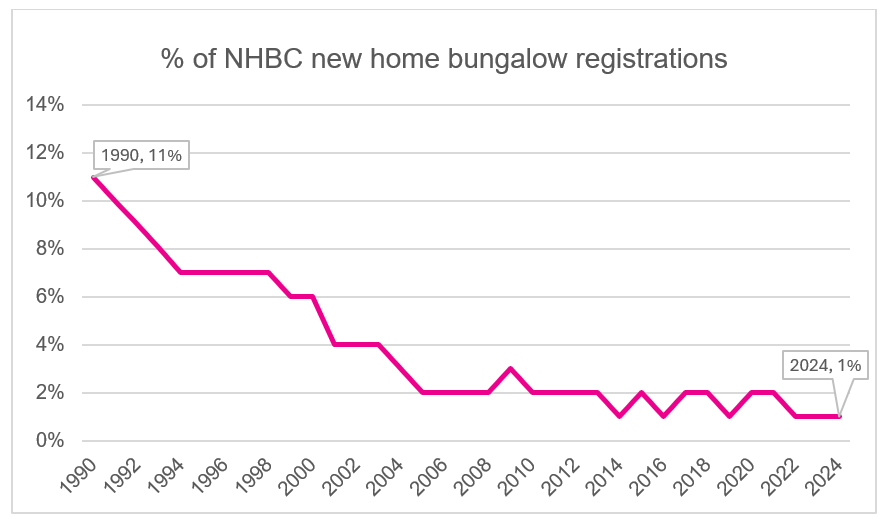
The shortage of bungalows is also a major issue, with 38% of homeowners aged 55+ saying they would prefer a bungalow for their next move, making bungalows the most popular choice among this group. However, builders are turning away from them, as NHBC data shows they made up 11% of new homes in 1990, but just 1% in 2024.
There are other alternatives to buying a bungalow that you may consider:
Building a granny flat, or annexe.
Do you have a loved one who has, or can build, an annexe? This is a self-contained unit that’s either joined onto or adjacent to a main and usually larger building.
In most cases, it will offer a degree of independent living that gives it the feel of the occupier’s own space and contain a living area, kitchen, bathroom and bedroom.
At 78, Peter Potter’s health issues, which have left him in a wheelchair, led to him deciding to sell his much-loved family home. But while he had hoped to buy a bungalow, the lack of stock and high prices led to him moving into his daughter’s garage instead.
Mr Potter said the few bungalows in his area, Woodford in east London, would have cost him £700,000 for poor condition and poor location: “By the time you’ve paid stamp duty and moving costs, there is not a lot of equity left.”
With no options available, Mr Potter’s daughter, Sarah, decided to convert the L-shaped garage at the end of her garden which is now a wheelchair-friendly flat with a small lounge, kitchen, bedroom and bathroom. The conversion cost £120,000.
Sarah said: “We decided to take the plunge. It ticks all the boxes and it was affordable. Having dad at the bottom of the garden will mean we can care for him, but we all have our own space.”
Retirement properties
Another alternative to buying a bungalow may be a retirement property. These are built specifically for over 55s, although some are only available to those over 60 or over 70. These are usually flats, although they can be houses or bungalows.
Retirement properties often come with communal areas and on-site amenities such as a communal garden. However, there are lots of potential downsides to consider including expensive fees if you sell or sublet, poor resale value, high ground rent and steep service charges, even when unoccupied. Read more in our guide on the Hidden costs of retirement properties.
Frequently Asked Questions
Are bungalows cheaper than houses?
– Not usually. In many areas, bungalows actually cost more per square foot than comparable houses because they require larger plots and there are fewer of them on the market.
– However, you may find cheaper bungalows where the property is dated or needs renovating, the layout is awkward, in a less in-demand area, or the plot is small or overlooked.
Are bungalows hard to sell?
Not typically. There’s usually strong demand from downsizers, retirees and buyers with mobility needs. In some regions, this buyer pool outweighs supply, helping bungalows retain value and sell steadily, provided the price and condition are right.
How do you pronounce “bungalow”?
It is pronounced “bung-ga-low”, with three syllables.
Is a bungalow a good investment?
– Often, yes, especially in areas with an ageing population or strong demand for step-free living. Bungalows tend to hold their value well, appeal to a steady buyer pool and offer good scope for extensions or loft conversions.
– However, investment value depends on location, condition and plot size.
What is a chalet bungalow?
– A chalet bungalow is a bungalow with living space in the roof, typically featuring dormer windows and an upper-floor bedroom or two. They offer more space than a standard bungalow and better separation between living and sleeping areas.
– However, the upper rooms can sometimes have sloping ceilings, smaller windows, or limited head height.
Are bungalows more expensive than houses?
– Yes, bungalows tend to command a premium because they require larger plots for the same internal space, demand is high, particularly from older buyers and downsizers and there’s limited supply.
– But you may see lower prices if the property is dated or requires modernisation, the layout is poor, it has limited extension potential or it’s overshadowed or overlooked by neighbouring homes.