


Find the best estate agent near you Start here
Getting an Energy Performance Certificate (EPC) is usually required if you’re selling or renting out a property. Before booking an assessment, check whether your property already has a valid EPC. If it doesn’t, you’ll need an accredited Domestic Energy Assessor to inspect your home and produce a new certificate.

KEY INFORMATION

Getting an Energy Performance Certificate is a straightforward process. If your property doesn’t already have a valid EPC, you’ll need to arrange an assessment with a qualified and accredited Domestic Energy Assessor, who will visit your property and carry out a visual inspection.
To get an EPC:
Your estate agent may offer to arrange the EPC for you, but it may cost more than booking an assessor directly. Using our EPC comparison service, you can get instant quotes from local accredited assessors, making it quicker to compare prices and potentially avoid paying more than you need to.
Need a new EPC? Compare instant quotes from accredited Domestic Energy Assessors in your area.
Get instant quotes and compare prices from Domestic Energy Assessors in your local area.
You don’t usually need to do extensive preparation before an EPC assessment, but making the property accessible and gathering relevant paperwork can help the assessor record your home accurately.
Make sure the assessor can access:
Since changes to the EPC assessment methodology introduced in 2025, assessors may need more detailed evidence of some improvements, so keeping relevant paperwork can help ensure they are reflected in your assessment.
It’s also useful to have evidence of energy-efficiency work you’ve carried out, such as:
If you’re preparing to sell, see our guide to the 11 documents you need to sell your house.
During an EPC assessment, an accredited Domestic Energy Assessor will carry out a visual inspection of your property and collect information about features that affect its energy efficiency.
They will typically look at:
The assessor may also take photographs and measurements as evidence for the assessment.
They will then use the information collected to calculate your property’s EPC rating and produce the Energy Performance Certificate, along with the assessor’s recommendations for improving the property’s energy efficiency.
An EPC assessment usually takes around 45 minutes to an hour, although it may take longer for a larger or more complex property.
After the assessment, it can take from a couple of hours to a few days for the assessor to produce and send your EPC. Ask how quickly you’ll receive the certificate before you book, particularly if you need it urgently.
The whole process, from comparing quotes, booking a visit, the EPC assessment and getting the report typically takes around 10 days.
In order to calculate the EPC on a property, a qualified Domestic Energy Assessor will visit the property and inspect it. They will score various aspects of the building based on how energy efficient they are and what condition they are in.
The assessor will be looking at where there is potential for a building to lose heat or energy, checking the insulation levels, looking at how efficient your heating system is and whether you are using energy efficient products such as light bulbs.
The information collected during the assessment is used to calculate an overall energy-efficiency score, which determines the property’s EPC rating from A to G.
| EPC Grade | Colour on EPC | Points |
|---|---|---|
| A | Dark Green | 92+ |
| B | Green | 81-91 |
| C | Light Green | 69-80 |
| D | Yellow | 55-68 |
| E | Light Orange | 39-54 |
| F | Orange | 21-38 |
| G | Red | 1-20 |
An EPC costs around £65 on average, according to Reallymoving’s Cost of Moving Report, which is based on quote data from 181,000 home movers, although prices vary depending on the property, where you live and the assessor you choose.
HomeOwners Alliance found significant differences between assessors when we spot-checked EPC quotes in October 2026, so it’s worth comparing prices before you book.
For a full breakdown of prices and our latest research, see our guide to how much an EPC costs. Or, if you’re ready to book, compare instant EPC quotes from accredited assessors in your area.
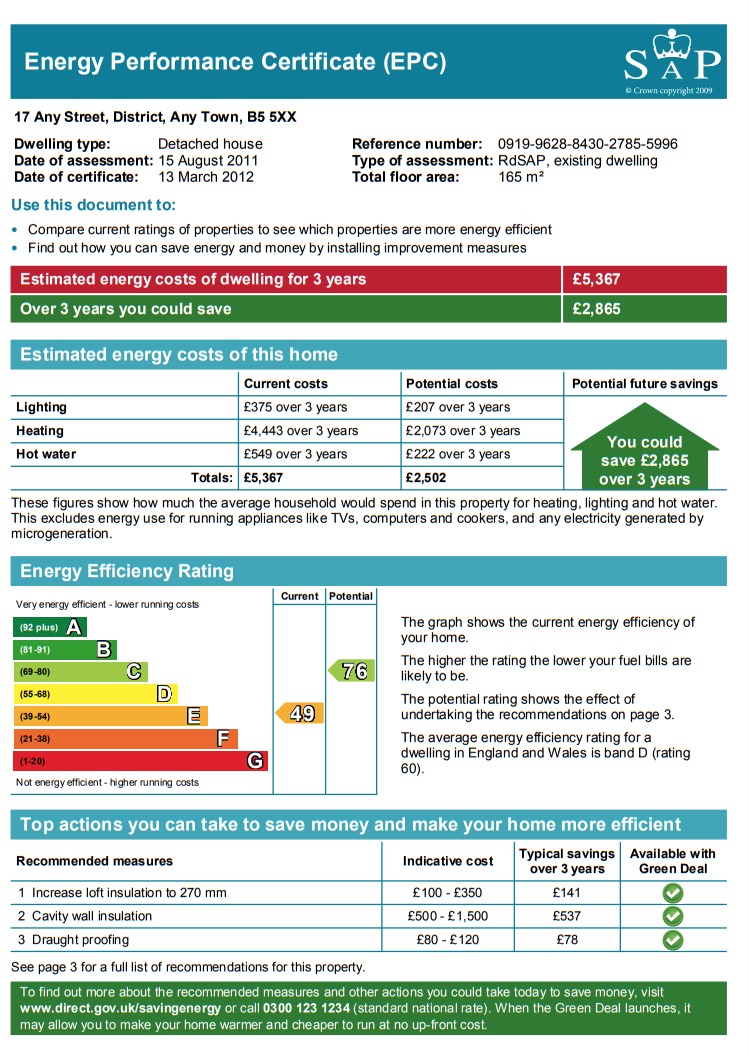
An Energy Performance Certificate (EPC) shows how energy efficient a property is, with a rating from A, the most energy efficient, to G, the least efficient. It also gives information about the property’s energy use and recommendations for improving its energy efficiency.
Your Energy Performance Certificate includes:
The government have an example EPC that explains each section set out below. You can also find out more with our complete guide to energy performance certificates.
Yes, if you are selling your home, renting out a property or building a property in England, Wales or Northern Ireland you will need an EPC in most cases. It must be available for potential buyers or tenants to look at, so you need to get it organised as soon as you decide to market the property. If an EPC isn’t available, you could be fined.
There are, however, some buildings that don’t require an EPC. These include:
Listed buildings may be exempt from needing an EPC, although the government says ‘you should get advice from your local authority conservation officer if the work would alter the building’s character’. You’re unlikely to know what work is proposed until you’ve had an EPC carried out, so it’s probably a good idea to speak to your local authority in advance if you’re thinking of proceeding with selling a Listed building without one.
Get instant quotes and compare prices from Domestic Energy Assessors in your local area.
If you’re selling or renting out a property in England and Wales and there isn’t already a valid EPC, you must commission one before the property is put on the market. You must then use all reasonable efforts to obtain it within seven days, although a further 21 days is allowed if after using all reasonable efforts the EPC cannot be obtained within 7 days, the government says.
Northern Ireland and Scotland have separate EPC rules. In Northern Ireland, an EPC is required when a property is marketed for sale or rent. In Scotland, an EPC is required when a property is sold or when it is let to a new tenant
An EPC lasts for 10 years. You only need a new Energy Performance Certificate if you’re selling or letting a property after your current EPC expires.
You may choose to get a new one sooner if you’ve made energy efficiency improvements and want to demonstrate to prospective buyers an improved energy rating for your home. But the existing EPC on the property, if you have one, is still valid if under 10 years old.
Not necessarily. A valid EPC normally remains valid for 10 years, even if you make improvements to the property.
However, you may choose to get a new assessment if you have carried out significant energy-efficiency improvements and want your current EPC rating to reflect them.
If you do get a new EPC, make sure you have evidence of the improvements, such as invoices, guarantees or certificates, available for the assessor.
Organise your EPC. Get instant quotes from Domestic Energy Assessors in your local area.
Get instant quotes and compare prices from Domestic Energy Assessors in your local area.
As an EPC is needed when you market a property, the seller or landlord usually pays for it. But before you pay, make sure you check there isn’t already an EPC for your property. They are valid for 10 years so a previous owner may have covered the costs for you.
Yes you can book an EPC online for an energy assessor to come and provide an assessment and issue a new EPC, but the assessment needs to happen in person and can’t be conducted online. However, it should be a swift straightforward process.
If your property already has an EPC, you can get that energy performance certificate online. You can search for a certificate on the government’s online database.
There is no pass or fail with an EPC. Every property is graded from A to G. However, most privately rented homes in England and Wales must currently have an EPC rating of at least E, unless a valid exemption applies. If the property is below E, you may need to make improvements or register an exemption before letting it.
You do not need to pay for an EPC on a property you are buying. The seller is responsible for providing a valid EPC where one is required, so ask the estate agent for a copy.
It can matter to buyers, particularly if the property has a low EPC rating or the recommended improvements could be costly. An EPC can help buyers understand how energy efficient a home is, what improvements may be needed and the potential running costs.
However, the EPC rating is usually just one of many factors buyers will consider alongside the property’s price, location, condition and overall suitability. Find out more with our guide to the importance of an EPC when buying a house.
HomeOwners Alliance Ltd is registered in England, company number 07861605. Information provided on HomeOwners Alliance is not intended as a recommendation or financial advice.
HomeOwners Alliance Ltd is an Introducer Appointed Representative of Mortgage Advice Bureau (Derby) Limited which is authorised and regulated by the Financial Conduct Authority.
If you take out a mortgage or protection product through Mortgage Advice Bureau, they pay us a referral fee of 25%. You are not obliged to use their services.
HomeOwners Alliance Ltd is an Introducer Appointed Representative (IAR) of LifeSearch Limited, an Appointed Representative of LifeSearch Partners Ltd, authorised and regulated by the Financial Conduct Authority. (FRN: 656479).
Independent Financial Adviser service is provided by Unbiased, who match you to a fully regulated, independent financial adviser, with no charge to you for the referral.
HomeOwners Alliance Ltd is an Introducer Appointed Representative (IAR) of Fluent Money Limited, which is authorised and regulated by the Financial Conduct Authority. Calls may be monitored/recorded.


