


Find the best estate agent near you Start here
How much a house survey costs can vary hugely depending on the type of survey you get. We look at how much different types of surveys can cost, why the costs vary, what you get for your money and how to get survey quotes.

KEY INFORMATION

If the property you’re buying is worth £200,000 and you want a RICS Home Survey Level 1 – the most basic type – it could cost around £400.
But if you’re buying a £1 million home and you’re seeking a RICS Home Survey Level 3 – also known as a full structural survey – you’re likely to be paying upwards of £1,500.
To get an accurate idea of how much a house survey will cost, use our tool to get instant quotes:
Get instant house survey quotes from qualified surveyors in your area.
| LEVEL OF REPORT | WHAT IT COVERS | WHAT TYPE OF PROPERTY IS IT SUITABLE FOR? | TYPICAL COST |
|---|---|---|---|
| RICS Home Survey Level 1 | Visible defects and a condition rating, highlighting issues in need of urgent investigation | Standard properties, newer homes | £300 – £900 |
| RICS Home Survey Level 2 | Condition of property with relative importance of any problems, advice on issues and repairs needed | Standard properties in reasonable condition | £400 – £1,000 |
| RICS Home Survey Level 3 | This full structural survey gives in-depth view of property condition and can also include estimate of costs for repairing defects | Large, older, run down or unusual properties or if you’re planning major works. | £630 – £1,500 |
| Level of report | £100k – £249k | £250k – £349k | £350k – £499k | £500k – £1m |
|---|---|---|---|---|
| RICS Home Survey Level 1 | £300 – £500 | £500 – £600 | £600 – £700 | £700 – £900 |
| RICS Home Survey Level 2 / RPSA Home Condition survey | £400 – £600 | £600 – £700 | £700 – £800 | £800 – £1,000 |
| RICS Home Survey Level 3 | £630 – £800 | £800 – £900 | £900 – £1,100 | £1,000 – £1,500 |
These are indicative house survey costs to help you budget, rather than fixed quotes. The price you pay will depend on the survey type, the property’s size, value, age, condition and location, and the surveyor you choose. When comparing quotes, always check whether VAT is included.
The different types of surveys go into different levels of detail. As such, the cost varies too. So when you’re asking how much does a house survey cost, it’s important to establish what type you’re looking for.
The names of the different types of surveys may look different to what you’re expecting. In March 2021, the Royal Institution of Chartered Surveyors (RICS) introduced its Home Survey Standard, alongside updated report formats with clearer names:
A Home Survey Level 1 (previously a RICS Condition Report) typically costs between £300 and £900, depending on the location of the property and its value.
A Home Survey Level 2 (previously a Homebuyer survey) is more detailed and is the most popular option, according to RICS. The cost of a Home Survey Level 2 generally varies from £400 to £1000 depending on whereabouts the property is located and its value.
You can choose from two options in this category – a Home Survey Level 2 with or without valuation. If you choose a Home Survey Level 2 with valuation, this will also include a valuation and an insurance reinstatement value. Home Survey Level 2 with valuation costs from around £500.
Ask whether your quote includes the valuation, rather than assuming it is part of the standard price. Compare quotes for the same service, including VAT where applicable.
Compare Homebuyer Survey/ Home Survey Level 2 quotes from qualified surveyors in your area.
These surveys are offered by the Residential Property Surveyors Association (RPSA) rather than RICS. Home condition surveys are similar to the RICS Home Survey Level 2. They offer clear colour-coded ratings for quick identification of important issues. They also claim to offer jargon-free reports.
Home Condition Surveys typically cost between £400-£900.
A RICS Home Survey Level 3 is also known as a building survey or full structural survey. It provides the most detailed RICS home survey report, so it usually costs more than a Level 1 or Level 2 survey.
RICS Home Survey Level 3 – also known as a building survey or full structural survey – is the most thorough survey offered by RICS. Full structural surveys are more expensive, ranging from around £630 to £1,500 – or even more – depending on the size, value, condition and complexity of the property. But they can be a worthwhile investment. Here’s why:
Get instant quotes for a Building survey/ RICS Home Survey Level 3
When it comes to finding and choosing a surveyor, don’t just go with the one recommended by the estate agent. Instead, you can ensure you are getting a good surveyor at a fair price by comparing quotes from several different firms using our find a surveyor tool.
Get instant house survey quotes from qualified surveyors in your area.
Survey costs also vary by region. According to August 2026 data from Reallymoving, the average cost of a RICS Level 2 (Homebuyer) survey across the UK was £520. However, costs varied significantly by region, from £463 in the North East to £590 in London.
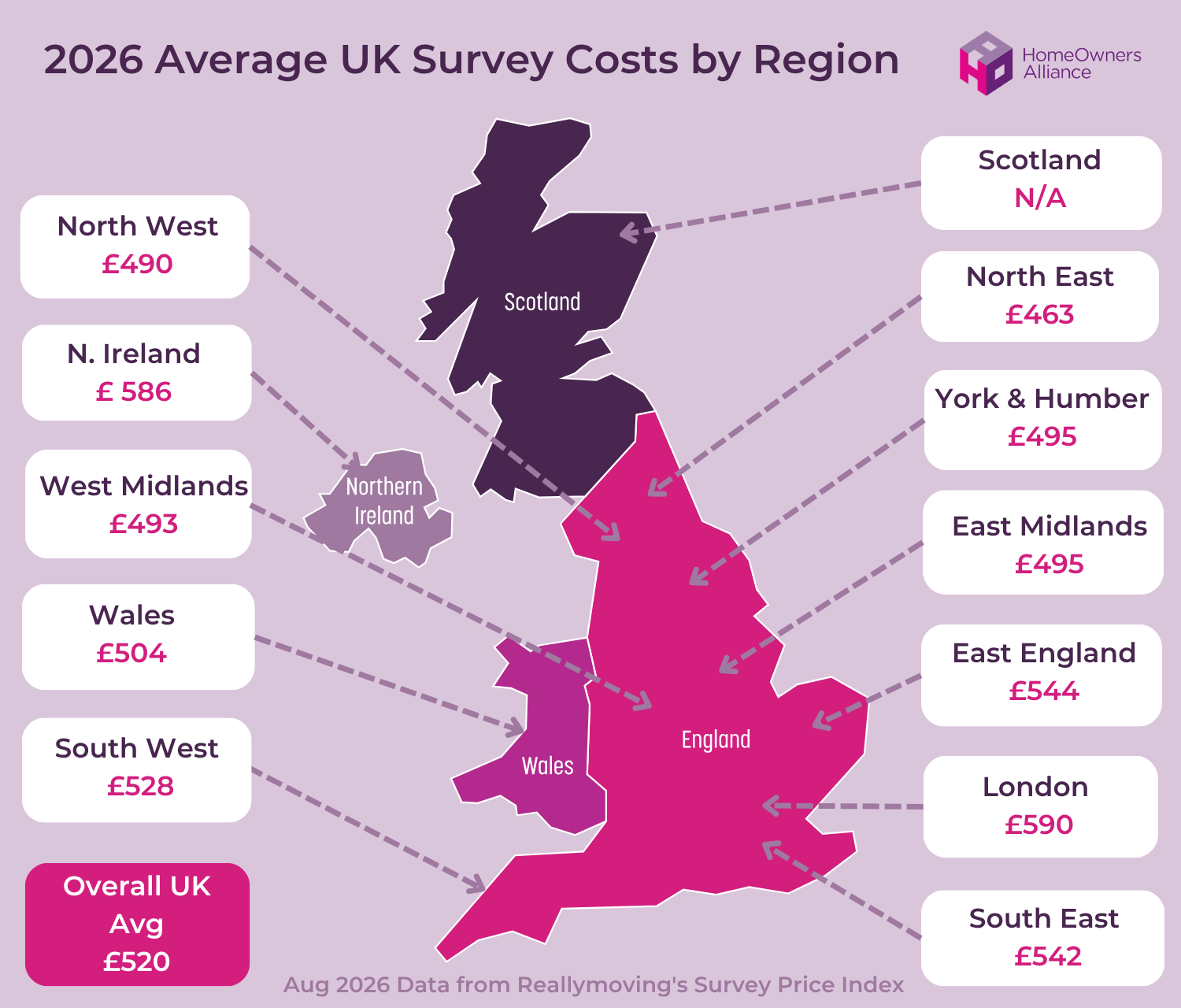
Bear in mind these are averages, and the amount you pay will depend on factors including the property’s value, size and condition. Compare quotes from local surveyors to find out how much a survey will cost for the property you’re buying.
Buying a house is expensive enough, so you don’t want to pay over the odds for your survey. Once you know the type of survey you need, shop around to get different quotes.
Get instant house survey quotes from qualified surveyors in your area.
The point of getting a house survey is to make you aware of potential pitfalls with the property. So yes, it can be well worth the cost. In fact, our research in 2024 found nearly a third (30%) of homebuyers who had a survey took action as a result of issues it flagged. Of those who had a survey, 10% renegotiated the purchase price and 9% got sellers to fix problems.
Research by Direct Line Home Insurance in 2026 found that 1 in 5 buyers surveyed in England, Wales and Northern Ireland skipped having a survey when buying a house. However, the same research also found that 53% of sellers admitted withholding certain information, with boiler or heating system faults most commonly concealed (7%), followed by drainage or plumbing problems, damp or condensation, and electrical issues (each 6%).
The level of detail will depend on which type of survey you choose. If you don’t have a property survey, there could be major – and expensive – problems with the property that you only become aware of after completion. So while having a survey may cost you in the short term, it could mean you avoid facing unexpected costs in the future.
Some people have a full structural survey every time they buy a house to ensure they have a comprehensive report of all the issues in front of them. Others want a light touch survey to reassure them of the fundamentals.
Find local qualified surveyors, get instant quotes and discuss your options now
Your initial house survey quote may be higher for a particularly large, older or unusual property, or one with extensive grounds, alterations or extensions. Tell the surveyor about these features when requesting a quote so they can recommend the appropriate service.
Before booking, check:
Your house survey can also cost more if your survey uncovers certain issues and your surveyor recommends that you get a specialist survey done.
We advise speaking to your surveyor first about the issues they have highlighted. They may be able to shed more light on the severity of the problem.
Read our guide for advice on Red flags on a house survey: what to look for and what to do next.
If you receive a bad house survey report on the property you’re planning to buy, there are a number of steps to take.
If you’re buying a new build home, you’ll want to get a snagging survey. These surveys can identify problems that range from small, cosmetic issues to significant, structural problems. Your new build snagging survey will ideally take place before completion, once the property is sufficiently finished to inspect. But if your developer won’t allow this, arrange for your new build snagging survey to be done as soon as you can after moving in. New build snagging surveys typically cost from £320.
A snagging report will:
Your new build snagging report will be sent to you so you can raise the issues with your developer. Check whether your inspector will also send the report directly to the developer.
If you’ve found your developer to be unresponsive to your calls for action, an independent snagging survey will add weight to your complaints.
HomeOwners Alliance is proud to have teamed up with one of the best known snagging inspectors in the UK, New Build Inspections. Unlike many other snagging companies, they never work for developers or builders so can retain their independence. Get a free, no obligation snagging survey quote from new build inspectors now.
A snagging survey is there to spot problems with your new build home. We can connect you with an independent on-site snagging inspector today.
When you apply for a mortgage your lender will carry out a valuation on the property. This is sometimes called a valuation survey – a term which often causes confusion. A mortgage valuation survey assesses whether the property is suitable security for the loan.
It may be carried out remotely or involve a limited inspection. It is for the lender’s benefit and doesn’t take the place of a house survey to assess the property’s condition.
Some lenders offer a free mortgage valuation on certain mortgage deals. But if you do need to pay, the cost of a mortgage valuation varies, this may be a flat fee or a sliding scale in line with the property value. Each lender has their own scale.
For example:
You don’t need to do the hard work of finding the right mortgage for you. Instead, get fee-free mortgage advice from the award-winning expert advisers at Mortgage Advice Bureau.
Get fee-free mortgage advice from the award-winning expert advisers at Mortgage Advice Bureau.
Your home may be repossessed if you do not keep up repayments on your mortgage. Please note some branches of Mortgage Advice Bureau may charge a fee for mortgage advice if you go direct. The fee is up to 1% but a typical fee is 0.3% of the amount borrowed. So make sure you use this site, this form or phone number for fee-free advice.
If you’re selling a property in Scotland you usually need to obtain a Home Report, which contains information about the condition of the property, which is available to prospective buyers for the duration the property is on sale. However, there are some exceptions to this rule, such as new homes sold off-plan or to their first occupier.
Home Reports in Scotland typically cost between £300 and £850, depending on the size of your home, its location and the surveyor you choose.
House surveys in London are typically more expensive. According to Reallymoving, the average Level 2 survey in London cost £590 in August 2026, compared with £520 nationally. That’s partly because the amount you’ll pay for house surveys will depend on the value of your house. And as London has the highest average house prices in the UK, this is reflected in that.
However, London is a busy market and there are lots of RICS Building Surveyors so competition is strong. Make sure you shop around.
Get instant quotes from qualified surveyors with our find a local surveyor tool
Yes, if you want the most thorough survey, are buying an older property, a listed property, a property in poor condition, or something of unusual construction or design, then it’s probably worth paying more. The same is true if you’re planning to carry out renovations. A full structural survey – also known as a RICS Home Survey Level 3 – is the most detailed type of survey offered by RICS. It is also the most expensive type of condition survey they offer.
A structural survey, also known as a building survey – or Home Survey Level 3 – will typically set you back between £630 and £1,500 – and potentially even more. The exact cost will depend on the size and value of the property, and where it’s located. Say, for example, you’re looking to purchase a £1 million property, you could expect to pay upwards of £1,500 for a full survey.
Yes sometimes. If it’s the cupboard under the stairs or it’s a cupboard that contains the boiler or electrics, then yes they will – as long as they can access it. But they’re unlikely to go through kitchen cupboards and wardrobes. Surveyors will also not lift floorboards or check any inaccessible areas of the property. Read more in our guide What does a surveyor do?
No, a property cannot officially ‘fail’ a survey, but it can be marked poorly with low condition ratings. Serious defects or urgent safety concerns should be explained in the report. The surveyor may, for example, flag significant structural problems they’ve found.
Some of the biggest survey problems include roof issues and damp. Based on this information, you may want to renegotiate the price or even decide not to proceed. See our guide on what to do after a bad house survey report.
This depends on the size of the property and the house survey type you choose. However, a RICS Level 1 survey may only take an hour to complete, a RICS Level 2 survey (previously known as homebuyer surveys) could take up to 4 hours, while a RICS Level 3 survey – a full structural survey –could take as long as a day to complete. Read more in our guide on House survey types and costs.
It’s best to organise your survey as soon as your offer on a house has been accepted. This shows the seller that you’re a serious buyer, it will speed up the buying process if you move quickly and if the survey reveals major problems, you can either negotiate a lower price or walk away.
The buyer typically organises a house survey and pays for it. The survey is for the benefit of the buyer as it will be carried out by a surveyor who will tell you the state of repair the house is in and possible risks with the property.
Homebuyers generally arrange to have a house survey done after their offer has been accepted by the seller. Read more in our guide Who arranges a house survey?
There is no fixed timescale from survey to completion. It depends on how far the conveyancing has progressed, whether there is a chain and whether the survey raises issues needing further investigation.
For example, if you get a bad house survey, and it shows the property is showing signs of subsidence the process will take longer as you’ll need to decide what to do about your purchase. Read more in our guide A bad house survey report: What to do next.
If you’re selling a house in England or Wales you don’t need a survey. It’s up to your buyers to organise one if they want to (which we recommend). However, if you’re selling a property in Scotland you usually need to obtain a Home Report, which contains information about the condition of the property, which is available to prospective buyers for the duration the property is on sale.
However, there are some exceptions to this rule. These include new homes sold off-plan or to their first occupier. Read more information in our guide on Who arranges a house survey?
HomeOwners Alliance Ltd is registered in England, company number 07861605. Information provided on HomeOwners Alliance is not intended as a recommendation or financial advice.
HomeOwners Alliance Ltd is an Introducer Appointed Representative of Mortgage Advice Bureau (Derby) Limited which is authorised and regulated by the Financial Conduct Authority.
If you take out a mortgage or protection product through Mortgage Advice Bureau, they pay us a referral fee of 25%. You are not obliged to use their services.
HomeOwners Alliance Ltd is an Introducer Appointed Representative (IAR) of LifeSearch Limited, an Appointed Representative of LifeSearch Partners Ltd, authorised and regulated by the Financial Conduct Authority. (FRN: 656479).
Independent Financial Adviser service is provided by Unbiased, who match you to a fully regulated, independent financial adviser, with no charge to you for the referral.
HomeOwners Alliance Ltd is an Introducer Appointed Representative (IAR) of Fluent Money Limited, which is authorised and regulated by the Financial Conduct Authority. Calls may be monitored/recorded.


