


Find the best estate agent near you Start here
Homebuyer surveys, also known as a RICS Home Survey Level 2 or Homebuyers Report, are the most popular survey buyers commission when purchasing a property. We look at whether homebuyer surveys are worth the money, how they compare to other types of house survey and how to get one.

KEY INFORMATION

Get instant Homebuyer Survey quotes from qualified surveyors in your area. Get Homebuyer Survey quotes now.
When you are buying a home, the results of the survey may lead to you renegotiating the price. For example, if your survey reveals that the house needs £15,000 of roof repairs it is fair to ask for £15,000 off the price or for the seller to fix the issue themselves before exchange of contracts.
Research by Direct Line Home Insurance in 2026 found that 1 in 5 of buyers skipped having a survey when buying a house. However, the same research also found that 53% of sellers admitted to withholding certain information, with boiler or heating system faults most commonly concealed (7%), followed by drainage or plumbing problems, damp or condensation, and electrical issues (each 6%).
A homebuyer survey (RICS Home Survey Level 2) is a mid-level survey that is often recommended for:
What does a homebuyers survey cover? A RICS Level 2 homebuyers survey checklist typically includes:
When describing the condition of the property, your Homebuyer survey report will give ‘condition ratings’ for the main parts of the building, garage and some outside parts.
RICS defines these as:
The RICS Home Survey Level 2 isn’t the only type of survey you can get. You can also get a RICS Home Survey – Level 1, (also known as a Condition Report) and a Building Survey, also known as a Full Structural Survey or RICS Home Survey – Level 3.
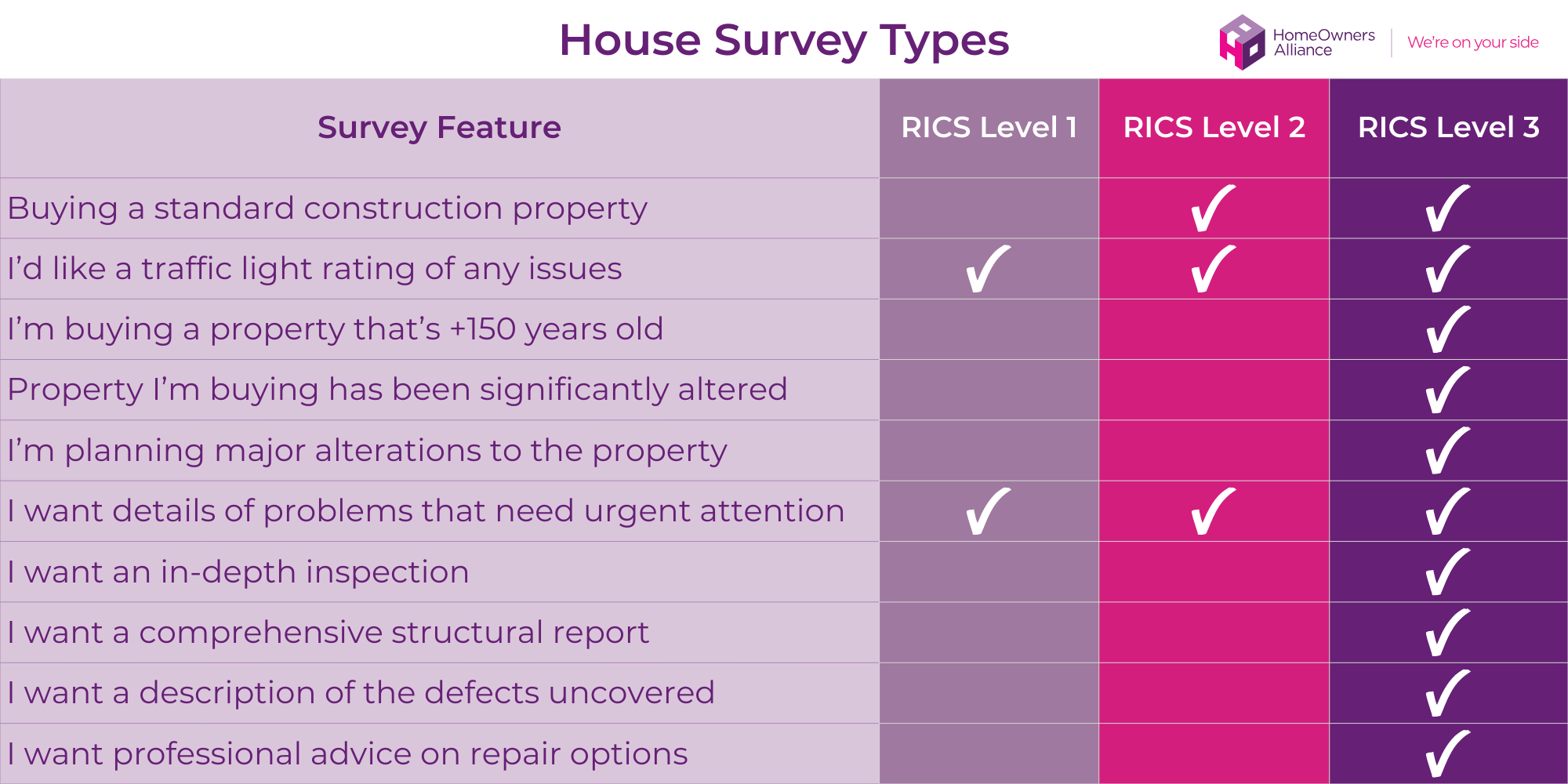
A RICS Level 1 survey is the most basic and cheapest survey and it’s suitable if you’re buying a conventional property built from common building materials and in reasonable condition.
It covers the basic condition of the property highlighting problems that may require attention and an assessment of the relative importance of the problems. However, it won’t go into much detail and there’s no advice or valuation.
The main difference between a RICS Level 2 home survey and a RICS Level 3 building survey is the level of detail provided.
A RICS Level 2 home survey (Homebuyer survey) could be the best choice if the property is:
A Building survey will give you the most in-depth report on the property you are considering buying. But you may not need the level of detail it provides.
If you are buying a modern home in a reasonable condition then a Homebuyer survey (RICS Level 2), may be all you need.
A Building survey may be a good idea if you want to know as much as possible about the property you are buying. They are also recommended if the property you’re dealing with is:
You should also consider a Building survey if you are planning major renovations or extensions to the building.
Read our guide on the different types of house survey for a more detailed explanation.
So how much does a RICS Level 2 homebuyer survey cost? This will vary depending on factors including the size and location of your home, but a RICS Level 2 survey will typically cost between £400-£1000. According to Reallymoving, the average Level 2 survey cost £520 across the UK in August 2026, ranging from £463 in the North East to £590 in London.
For more information, read our guide on how much house surveys cost.
The buyer usually arranges and pays for the homebuyer survey.
Homebuyer surveys aren’t cheap which is why some people ask is it worth having one? Buying a home is expensive so it’s understandable that commissioning a survey may feel like yet another expense.
However, homebuyer surveys can help you avoid costly surprises further down the line like discovering a damp problem. Having a homebuyer survey also offers peace of mind that the property is in good condition.
Considering the amount of money you are spending on the house, paying a few hundred pounds on getting an expert’s advice seems like a good investment.
If your survey uncovers any problems you can then either renegotiate the price, agree the seller fixes the problem before you move in or decide to reconsider your purchase. And if the seller won’t budge on price and you still want to buy, at least you can budget for any required repairs.
We would particularly recommend getting a survey when buying a house if:
It’s common for issues to arise on homebuyer surveys, particularly with older properties.
When you’re arranging your homebuyer survey, you can typically agree with the surveyor in advance for them to provide the costing of any repairs as an extra service. So, if you’re concerned about any issues and your survey hasn’t been completed yet, you may consider requesting this.
The biggest concerns will be if any structural problems, roof problems and damp are highlighted in the report. These can be costly to fix.
But, sometimes a number of less substantial issues can be flagged, which can be equally overwhelming. In order to get some perspective on these issues and be clear on the order of magnitude, we recommend speaking to your surveyor about the report findings.
Homebuyer surveys will highlight any red flags and leave you with enough information to decide next steps. These might include:
Ultimately, you may decide the number of red flags on the house survey mean you have to walk away from the purchase.
For more information read our guide Red flags on a house survey: what to look for and what to do next.
Yes. If you have any particular concerns about the property you can highlight these to the surveyor before booking your homebuyer survey. And you can go with them when the survey is carried out and ask questions too.
What are the most common things you may want to investigate? These may include:
You can view an example Homebuyers’ Report from RICS. But once you have your chosen surveyor, it’s best to ask them to send you an example in case they have customised the standard version and so you know what to expect.
If you’re selling a property in Scotland, it’s a legal requirement to have a survey before you sell your property.
No. A mortgage valuation survey is a basic check carried out on behalf of your mortgage lender to make sure the property is worth the amount being paid for it. The mortgage lender does a valuation survey to make sure their loan is safe and could be recouped by selling the property if necessary. It is not a detailed survey into the condition of the property.
Homebuyer surveys may seem like just another cost but they can help you avoid expensive surprises later on like discovering a damp problem. Bearing in mind the amount of money you’re spending on a house, a homebuyer survey may seem a wise investment. Read more about the different types of surveys you can get in our guide on House survey types and costs.
Homebuyer surveys usually takes between 90 minutes and four hours to complete, although it may take longer if there are access issues. Read more in our guide on How long does a house survey take?
During a RICS Homebuyer Survey (Level 2), a surveyor inspects the property and identifies visible problems that may affect its condition or value, and which need further investigation like subsidence and damp.
Yes. With homebuyer surveys, as part of the inspection, the surveyor will assess any damp-proofing and test walls for damp. Read more about the different types of surveys you can get in our guide on House survey types and costs.
A Level 2 survey, also known as a RICS Homebuyer Survey or Homebuyers Report, is a mid-level survey carried out by a surveyor. It assesses the visible condition of a property and highlights issues such as damp, roof defects or structural movement that may need further investigation.
Level 2 surveys are usually suitable for standard properties in reasonable condition that haven’t been significantly altered.
HomeOwners Alliance Ltd is registered in England, company number 07861605. Information provided on HomeOwners Alliance is not intended as a recommendation or financial advice.
HomeOwners Alliance Ltd is an Introducer Appointed Representative of Mortgage Advice Bureau (Derby) Limited which is authorised and regulated by the Financial Conduct Authority.
If you take out a mortgage or protection product through Mortgage Advice Bureau, they pay us a referral fee of 25%. You are not obliged to use their services.
HomeOwners Alliance Ltd is an Introducer Appointed Representative (IAR) of LifeSearch Limited, an Appointed Representative of LifeSearch Partners Ltd, authorised and regulated by the Financial Conduct Authority. (FRN: 656479).
Independent Financial Adviser service is provided by Unbiased, who match you to a fully regulated, independent financial adviser, with no charge to you for the referral.
HomeOwners Alliance Ltd is an Introducer Appointed Representative (IAR) of Fluent Money Limited, which is authorised and regulated by the Financial Conduct Authority. Calls may be monitored/recorded.


