Find the best estate agent near you Start here
Choosing between a two or five year fixed mortgage comes down to flexibility versus certainty. A two year fix lets you benefit sooner if rates fall, while a five year fix offers longer term security but may cost more if rates drop. Here's everything you need to consider.

KEY INFORMATION

Choosing between a 2 or 5 year fixed mortgage? Here are the key differences:
| Feature | 2 year fix | 5 year fix |
|---|---|---|
| Rates | Typically slightly lower | Typically slightly higher |
| Stability period | 2 years | 5 years |
| Flexibility | May be easier to move. Can remortgage sooner | Ties in for longer |
| Early repayment charges | Usually apply, typically lower | Usually apply, typically higher in the first years |
| Best for | Rate watchers or movers | Long-term stability seekers |
However, whether a 2 or 5 year fixed mortgage is best for you will depend on your circumstances. So get expert advice from a fee-free mortgage broker.
A fixed rate mortgage is a home loan where the interest rate and monthly payments stay the same for a set period, offering homeowners stability and making budgeting easier.
This is different to variable rate mortgages where the rate you pay can go up and down. For example, if you take out a fixed rate mortgage at 4%, your monthly repayments stay the same even if the Bank of England base rate changes.
2 or 5 year fixed mortgages are the most common, but you can also get fixed deals for 3 years, 10 years or even longer.
Fixed rate mortgage deals are by far the most popular type of mortgage. UK Finance statistics from May 2025 show that 85% of outstanding mortgages are fixed rate mortgages compared to 7% on tracker mortgages and 6% on the standard variable rate.
Get fee free mortgage advice from our partners at L&C. Use the online mortgage finder or speak to an advisor today.
A 2 year fix may be best if you:
However, if you’d prefer more stability, a 5-year fixed deal could be a better fit – here’s how it compares:
A 5 year fix may be best for you if you:
Get fee free mortgage advice from our partners at L&C. Use the online mortgage finder or speak to an advisor today.
When you’re deciding between 2 or 5 year mortgages, here are some of the key differences to consider.
Interest rates and monthly payments on 2 and 5 year fixed mortgages are fairly similar in winter 2026, however rates on 2 year fixed rates deals are generally a bit cheaper.
Here are the best fixed mortgage rates in the UK today if you’re looking for a 2 or 5 year fixed mortgage deal.
| Lender | Initial Rate | Fees | Monthly payment | APRC | Annual Cost | Max LTV |
|---|---|---|---|---|---|---|
| Nationwide | 4.71% | £999 | £1,038 | 6.2% | £12,961 | 60% |
| Natwest | 4.75% | £1,495 | £1,043 | 6.4% | £13,267 | 60% |
| Yorkshire BS | 4.76% | £995 | £1,045 | 6.4% | £13,032 | 60% |
| Natwest | 4.80% | £995 | £1,049 | 6.4% | £13,089 | 60% |
| Principality | 4.80% | £1,499 | £1,049 | 6.4% | £13,341 | 65% |
| Lender | Initial Rate | Fees | Monthly payment | APRC | Annual Cost | Max LTV |
|---|---|---|---|---|---|---|
| Natwest | 4.79% | £1,454 | £1,048 | 6.4% | £13,304 | 60% |
| Principality | 4.80% | £1,808 | £1,049 | 6.4% | £13,496 | 65% |
| Natwest | 4.84% | £954 | £1,054 | 6.4% | £13,127 | 60% |
| Principality | 4.86% | £1,204 | £1,057 | 6.5% | £13,281 | 65% |
| Natwest | 4.87% | £1,454 | £1,058 | 6.4% | £13,421 | 75% |
| Lender | Initial Rate | Fees | Monthly payment | APRC | Annual Cost | Max LTV |
|---|---|---|---|---|---|---|
| Yorkshire BS | 4.77% | £995 | £1,046 | 6.0% | £12,748 | 60% |
| Yorkshire BS | 4.79% | £995 | £1,048 | 6.0% | £12,776 | 75% |
| Yorkshire BS | 4.79% | £995 | £1,048 | 6.0% | £12,776 | 60% |
| Yorkshire BS | 4.81% | £995 | £1,051 | 6.0% | £12,805 | 75% |
| Yorkshire BS | 4.83% | £995 | £1,053 | 6.0% | £12,835 | 80% |
| Lender | Initial Rate | Fees | Monthly payment | APRC | Annual Cost | Max LTV |
|---|---|---|---|---|---|---|
| Yorkshire BS | 4.80% | £995 | £1,049 | 6.0% | £12,791 | 60% |
| Nationwide | 4.80% | £808 | £1,049 | 5.8% | £12,754 | 60% |
| Yorkshire BS | 4.81% | £995 | £1,051 | 6.0% | £12,805 | 75% |
| Santander | 4.83% | £1,058 | £1,053 | 5.9% | £12,847 | 60% |
| Yorkshire BS | 4.85% | £995 | £1,055 | 6.0% | £12,864 | 60% |
When you take out a 2 or 5 year fixed mortgage, it’s likely that you’ll need to pay an early repayment charge if you leave your deal early by remortgaging, paying off the balance, or by overpaying on your mortgage by more than your lender allows.
Early repayment charges tend to be higher for 5 year fixed rate mortgages compared to 2 year fixed rate mortgages.
For example, here are the early repayment charges for Nationwide’s 2 year fixed rate mortgage vs a 5 year fixed rate mortgage.
| 2 year fix | 5 year fix | |
|---|---|---|
| Year 1 | 2% | 5% |
| Year 2 | 1% | 4% |
| Year 3 | 3% | |
| Year 4 | 2% | |
| Year 5 | 1% |
Using Nationwide’s figures, if you have an outstanding mortgage of £200,000 and need to pay the early repayment charge in year 1:
A common question when deciding between a 2 or 5 year fixed mortgage is what is likely to happen to mortgage rates in the future?
Some people worry about locking in a rate for 5 years now in case mortgage rates fall in the future, while others are wary of taking a 2 year fixed mortgage in case mortgage rates increase.
Sadly, there is no crystal ball we can gaze into. While mortgage rates may fall in 2026, there is no certainty that this will happen and if so, by how much. Read more detailed analysis in our guide on Mortgage rate predictions.
Still not sure how to choose between a 2 or 5 year fixed mortgage? Here’s what you need to weigh up:
When choosing between a 2 or 5 year fixed mortgage, you’ll need to weigh up the risk of potentially paying a higher rate than you need to for longer by taking a 5 year fix if rates fall versus taking out a 2 year fix and potentially having to remortgage onto a higher rate in a couple of years if mortgage rates increase.
One factor to consider is how much room you have in your budget. If you think you may struggle to afford higher mortgage payments if rates go up, you may prefer the security of a 5 year fix over a 2 year deal. However, before making a decision on whether to get a 2 or 5 year fixed mortgage, it’s a good idea to discuss it with a fee-free mortgage broker.
The Bank of England is predicted to make further interest rate cuts in 2026. However, no one knows how quickly this will happen or how low interest rates could go. Find more on interest rate predictions and what this could mean for mortgage rates in our guide on Mortgage rate predictions.
When you’re deciding between a 2 or 5 year fixed mortgage, consider how long you’ll stay in the house. Even if your mortgage is portable, there’s no guarantee your lender will let you do it.
So if you plan to move house within the next few years, a 2 year fixed mortgage deal (or 3 year fix) may be better for you.
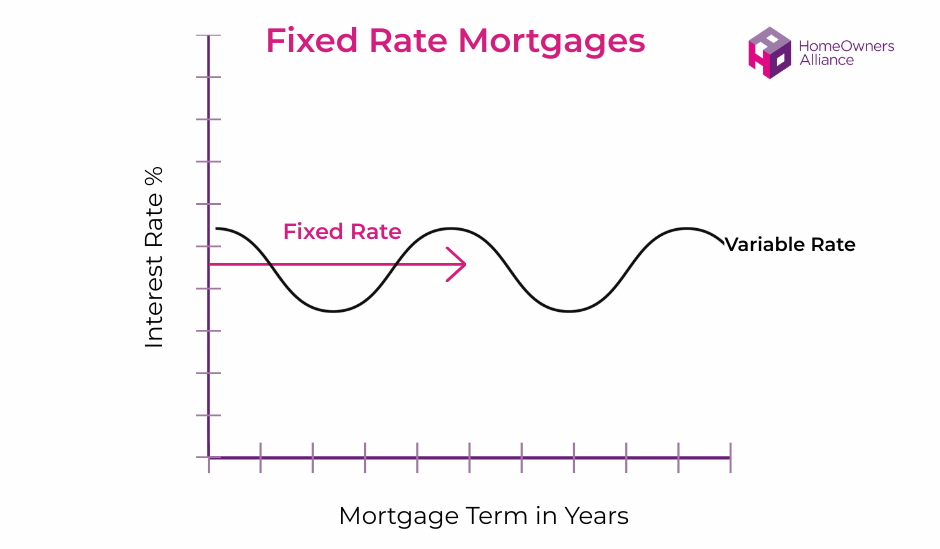
You may also consider taking out a tracker mortgage or discounted variable rate mortgage instead of a fixed deal. You can get 2, 3, 5 and 10 year variable rate mortgage deals in the UK.
These may be appealing if you think interest rates may come down in the future and you want to benefit from lower mortgage payments (however your payments can also go up with variable rate mortgages).
| Mortgage type | How it works |
|---|---|
| Tracker mortgages | The rate you pay goes up and down in line with the Bank of England base rate. It may have a tracker floor, which limits how low your mortgage rate can go. Some tracker mortgages include a cap which limits the interest rate you’ll pay on your mortgage. |
| Discounted variable rate mortgages | These track under the lender’s standard variable rate. So your rate may go up or down, depending on any changes the lender makes to its standard variable rate. |
You can also get standard variable rate mortgages, but this is the deal you’ll usually roll onto when your current mortgage deal ends if you don’t remortgage. The lender sets the amount you pay and these are notoriously expensive.
Here are some examples of when a 2 or 5 year fixed mortgage may work best. Although, what’s best for you will depend on your circumstances – so always get expert mortgage advice.
If you’re buying a home but only plan to live there for a few years, you may prefer to take out a 2 year fix, or a 3 year fixed rate mortgage, rather than a longer-term 5 year fix. This gives you more flexibility.
If you plan to stay put for several years, you may decide a 5 year fixed mortgage offers the peace of mind you’re after. With your rate locked in for a longer period, your monthly repayments stay consistent, even if the wider market sees rate increases.
This stability can make budgeting easier and protect you from unexpected jumps in interest rates. The trade-off is that you will be tied into your deal for longer, and early repayment charges usually apply if you remortgage before the term ends.
Buy to Let investors choosing between 2 or 5 year fixed mortgages may consider:
Choosing between a 2 or 5 year fixed mortgage? Here’s an overview of the best mortgage rates available in the UK today at different deposit levels. Plus, the best rates on a 2 year tracker to help you compare.
| Loan-to-value | 2 year fixed rate (+fee) | 5 year fixed rate (+fee) | 2 year tracker (+fee) |
|---|---|---|---|
| 95% LTV |
5.50% (£499)
|
5.40% (£199)
|
4.74% (£999)
|
| 90% LTV |
5.15% (£999)
|
5.04% (£1,499)
|
4.38% (£999)
|
| 75% LTV |
4.77% (£1,499)
|
4.79% (£995)
|
3.98% (£999)
|
| 60% LTV |
4.71% (£999)
|
4.77% (£995)
|
3.96% (£1,599)
|
Looking for the best mortgage rates on a 2 or 5 year fixed mortgage? We’ve partnered with award-winning mortgage brokers L&C who search 90+ lenders to help find you the best mortgage. Plus, unlike other brokers, they don’t charge a fee for their service.
Get fee free mortgage advice from our partners at L&C. Use the online mortgage finder or speak to an advisor today.
At the end of your 2 or 5 year fixed mortgage deal, you’ll usually move onto your lender’s standard variable rate. You can avoid this by remortgaging onto a better deal. Read more in our guide End of mortgage term: what happens?
Yes – you can switch from a 2 year fixed mortgage to a 5 year fixed deal once your initial term ends or, in some cases, earlier. Most homeowners remortgage at the end of their fixed period to avoid moving onto their lender’s Standard Variable Rate (SVR), which is usually higher.
If you want to switch before your 2 year deal ends, you’ll likely face early repayment charges (ERCs). These fees can be significant, so it’s important to check this.
Whether a 2 or 5 year fixed mortgage is better for you is a personal decision. A 2 year fix offers flexibility if you think mortgage rates may fall soon, while a 5 year fix gives longer-term stability and protection if rates rise. The best choice for you depends on your budget, your circumstances, and how long you plan to stay in your home.
Yes, but you’ll usually pay an early repayment charge (ERC) if you leave a 5 year fix before the end of the deal. These can be significant – often 1% – 5% of your outstanding balance. Check your lender’s terms or speak to a fee-free broker before making any changes.
Yes, they can be. A 3 year fixed mortgage offers a balance between short-term flexibility and longer-term stability. They can be a compromise if you’re unsure about future rate changes or how long you’ll stay in your property.
The advantages of fixing for 10 years or longer are that you’ll have the security of knowing how much you’ll pay on your mortgage for a longer period. Plus, you’ll usually pay less in arrangement fees than if you take out multiple 2 or 5 year mortgages. But fixing for such a long time means you’ll run the risk of potentially missing out on better deals. And consider what would happen if you move house. It’s important to get expert advice from a fee-free mortgage broker to help you weigh this up.
HomeOwners Alliance Ltd is registered in England, company number 07861605. Information provided on HomeOwners Alliance is not intended as a recommendation or financial advice.
Mortgage service provided by London & Country Mortgages (L&C), Unit 26 (2.06), Newark Works, 2 Foundry Lane, Bath BA2 3GZ, authorised and regulated by the Financial Conduct Authority (FRN: 143002). The FCA does not regulate most Buy to Let mortgages. Your home or property may be repossessed if you do not keep up repayments on your mortgage.
HomeOwners Alliance Ltd is an Introducer Appointed Representative (IAR) of LifeSearch Limited, an Appointed Representative of LifeSearch Partners Ltd, authorised and regulated by the Financial Conduct Authority. (FRN: 656479).
Independent Financial Adviser service is provided by Unbiased, who match you to a fully regulated, independent financial adviser, with no charge to you for the referral.
Bridging Loan and specialist lending service provided by Chartwell Funding Limited, registered office 5 Badminton Court, Station Road, Yate, Bristol, BS37 5HZ, authorised and regulated by the Financial Conduct Authority (FRN: 458223). Your property may be repossessed if you do not keep up repayments on a mortgage or any debt secured on it.