When you get to the end of your mortgage term, what happens? This depends on whether your repayment or interest-only mortgage term is ending or if your current fixed deal is coming to an end. We explain what happens and action you need to take.
Repayment mortgage term ends: At the end of your mortgage term your outstanding loan is usually paid off and the lender removes their charge from the property.
End of interest-only mortgage: What happens?: You must repay the full amount borrowed at the end of your interest-only mortgage term. If you can’t repay the lump sum, your options include extending your mortgage term, remortgaging, selling your property, or releasing equity.
Fixed mortgage deal ending: If you’ve taken out a fixed or variable rate mortgage, you’ll usually go onto your lender’s standard variable rate when this deal ends. You can avoid this by remortgaging onto a better deal.
Read on for more detailed information to the question of what happens when you get to the end of your mortgage term.
Repayment mortgage terms ends: What happens?
When you come to the end of your repayment mortgage term, often 25, 30 or 35 years, you will usually have paid off your mortgage and own your home outright.
Your lender will send you a final redemption statement, outlining everything left to pay on your mortgage in the final month.
As well as your final mortgage payment, you may need to pay a mortgage exit fee. If you do, these can cost up to £300.
After your mortgage has been completed, the lender will release the charge held on your property.
A letter confirming the account closure will be sent to you (or the solicitor acting on your behalf) and you’ll be refunded any money owed.
Your lender will arrange for any title deeds it holds to be sent for you.
Congratulations – you now own your home outright and will not have to make any further mortgage payments on it.
End of interest-only mortgage: What happens
When you take out an interest-only mortgage, your monthly payments only cover the interest charges on your loan – they don’t pay off any of the capital you have borrowed.
This is different to a repayment mortgage, where your repayments go towards paying off the capital borrowed as well as the interest on the loan.
Mortgage payments on interest-only mortgages are lower than with repayment mortgages, but at the end of the interest-only mortgage term you will still owe the original amount you borrowed. And you’ll need to repay this to your lender when your interest-only mortgage term ends.
For example, if you take out a £250,000 interest-only mortgage over 25 years, you’ll still owe £250,000 at the end of the term. You’ll need to repay this at the end of your interest-only mortgage term.
By comparison, if you take out a £250,000 capital repayment mortgage over 25 years, you will have paid off the mortgage fully at the end of the term if you make all your repayments.
You can also get ‘part and part’ mortgages, which are a combination of both repayment and interest-only mortgages. Find out more in our guide What is an interest-only mortgage?.
Your home may be repossessed if you do not keep up repayments on your mortgage. Please note some branches of Mortgage Advice Bureau may charge a fee for mortgage advice if you go direct. The fee is up to 1% but a typical fee is 0.3% of the amount borrowed. So make sure you use this site, this form or phone number for fee-free advice.
What happens when an interest-only mortgage term ends: Step-by-step process
When you get to the end of your mortgage term and it’s an interest-only deal, here’s what happens:
Your lender will typically contact you around a year before your interest-only mortgage term ends, and again at six months to go and just before the end of the term. You should ask for a redemption notice or statement, this will set out how much you need to pay.
The remaining balance of your interest-only mortgage needs to be made at the end of the term. So if you took out a £250,000 interest-only mortgage and haven’t repaid any of the capital, you will need to pay back £250,000.
Ideally, you will have the funds in place to pay this off. If you don’t and you own assets like property, you may choose to sell and use the cash to pay off your mortgage. Or you may be able to repay what you owe by withdrawing from one or more pensions at the end of the term. But make sure you take independent financial advice before doing this.
Interest-only end of term mortgage options if you can’t pay
If you can’t repay your interest-only mortgage at the end of the mortgage term you may have a number of options:
Extend the mortgage term: If you cannot pay off your interest-only mortgage when the term ends, then you can ask your lender to extend it. This will involve an affordability assessment but may give you several more years to pay off the remaining amount.
Remortgage: You may choose to look for a new mortgage deal. If you switch to a repayment mortgage, this means you’ll start paying off the capital as well as the interest. However, your options could be more limited depending on your age. It’s advisable to get expert mortgage advice if you’re remortgaging an interest-only mortgage to make sure you get the best mortgage for you.
Downsize: Consider downsizing to a less expensive home and use the extra funds from the sale of your home to pay off your interest-only mortgage. Although there will be moving costs to factor in, no least stamp duty. Read more in our guide Downsizing your house: The pros and cons.
Sell the property: If you’re a Buy to Let landlord with an interest-only mortgage to pay off, you could sell the property at the end of the term to repay the loan.
Here’s how interest-only mortgages work compared to capital repayment mortgages:
Interest-only mortgage
Capital repayment mortgage
An interest-only mortgage is a type of mortgage when you only pay the loan’s interest. At the end of the term, you need to pay back the original amount borrowed.
A capital repayment mortgage means you’ll pay off part of the mortgage and the interest each month. At the end of the term your mortgage will be paid off.
Your monthly mortgage payments will be lower.
Your monthly mortgage repayments will be higher.
There’s a higher risk of negative equity. This is because you won’t build up equity in your home via your mortgage payments which means you’re more exposed to changes in house prices.
You’ll build up equity in your home over time by making your mortgage repayments.
More expensive overall than a repayment mortgage as you’ll continue to pay interest on the original amount you borrowed.
A standard variable rate (SVR) mortgage is a type of variable rate mortgage you’ll usually be moved onto when your fixed-term mortgage deal ends.
For example, if you take out a 2 year fixed rate mortgage, you’ll usually be moved onto your lender’s standard variable rate at the end of the 2 year mortgage term unless you remortgage onto a new deal.
However, standard variable rate mortgages can be expensive and you may pay £100s a month more on your lender’s SVR compared to if you remortgage to a better deal.
Mortgage lenders set their own standard variable rates. These can be influenced by changes to the Bank of England base rate but unlike tracker mortgages, standard variable rates don’t track above the base rate at a fixed amount.
Plus, other factors like the cost of borrowing can influence what a lender sets its SVR mortgage rates at. And a lender can increase or decrease its SVR whenever it chooses to.
Easy option: Some people move onto their lender’s SVR when their mortgage term ends because they find the prospect of remortgaging too stressful. However, you could end up paying much more for your mortgage as a result. If you speak to a mortgage broker, they’ll do the hard work of finding the right mortgage for you.
Flexible: Some homeowners stay on the SVR because they want the flexibility of switching to a new deal without having to pay an early repayment charge. However, there are some mortgage deals available that offer this flexibility if you remortgage. So make sure to get expert remortgage advice.
Cheaper overall: A standard variable rate mortgage may be right for some people. For example, if you have a small mortgage balance it may be cheaper overall for you to stay on your lender’s standard variable rate than remortgaging onto a new deal. But don’t assume what the best option for you will be – always get expert advice.
Your home may be repossessed if you do not keep up repayments on your mortgage. Please note some branches of Mortgage Advice Bureau may charge a fee for mortgage advice if you go direct. The fee is up to 1% but a typical fee is 0.3% of the amount borrowed. So make sure you use this site, this form or phone number for fee-free advice.
2. Remortgaging onto a new deal
Most people can save money by remortgaging onto a new mortgage deal at the end of their current mortgage deal, compared to moving onto your lender’s standard variable rate.
If you can secure a lower mortgage rate than your current mortgage deal, your monthly mortgage repayments will go down.
However, even if your new mortgage rate is higher than your current rate you may still be able to save a significant amount of money each month compared to if you move to your lender’s standard variable rate.
Use our mortgage cost calculator to work out the cost of your mortgage at different rates.
How to remortgage your home
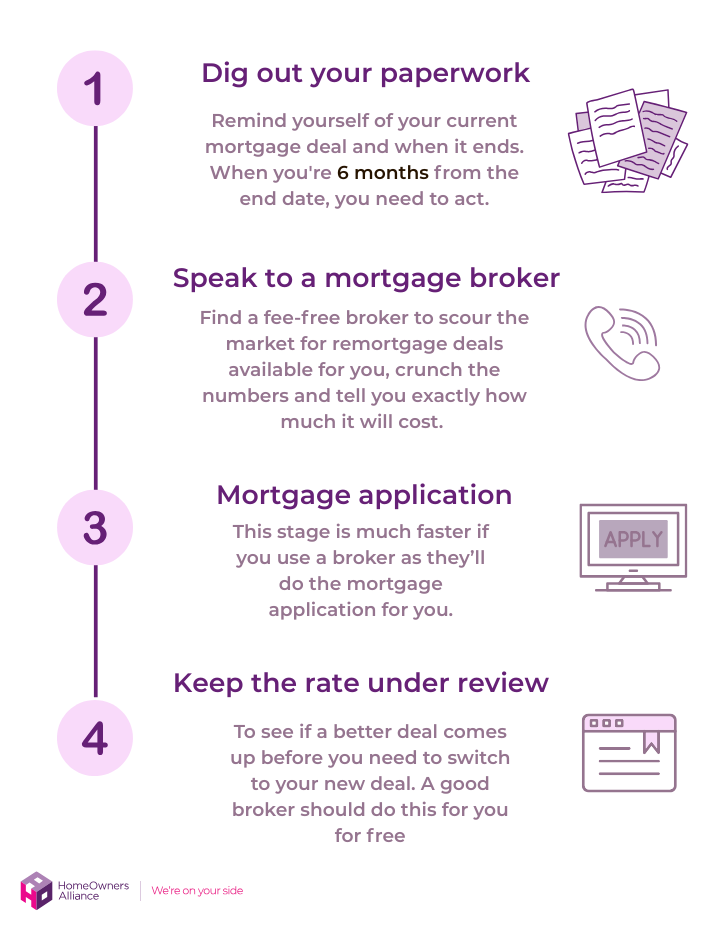
Here are the steps you’ll need to take to remortgage:
Dig out your paperwork. Remind yourself of your current mortgage deal. What type of mortgage are you on? What is the current interest rate? How long have you got left to pay? What are your monthly payments?
Speak to a mortgage broker. An expert mortgage adviser will find the best remortgage deals available for you. Plus, they’ll crunch the numbers taking into account any fees you’ll need to pay so you’ll know exactly how much it will cost. They can run through options like fixed rate mortgage deals and tracker mortgages.
Make your mortgage application. This stage can be much faster if you use a mortgage broker as they’ll do the mortgage application for you.
Keep the rate under review to see if a better deal comes up before you need to switch to your new deal.
Video: When & How to remortgage
Should you remortgage?
Remortgaging fees: how much will remortgaging cost?
These are the remortgaging costs you may need to pay:
Remortgaging Costs
How much?
Early repayment charge
Typically 1%-5%. May be payable if you remortgage before your deal ends.
Exit fee (also known as account fee)
Typically £50 – £300
Arrangement fee
If charged, this is typically £500-£1,500
Legal fees
Lender may include this for free. If not, typical costs are £300+
Mortgage valuation fees
Lender may include this for free. If not, typical costs are £100 – £1500
Early repayment charge
If you’re tied into a deal, you may have to pay an early repayment charge if you remortgage before the term ends. These are usually calculated as a percentage of the outstanding mortgage balance – usually 1%-5%.
Exit fees
Many lenders charge an exit fee for closing your mortgage account. These are usually between £50 – £300.
Arrangement fees
Lenders often charge arrangement fees when you take out a mortgage with them. These vary but generally cost £500-£1,500.
Legal fees
Legal fees are often included in remortgage deals but not always. Remortgage legal fees can cost from £300.
Valuation fees
Mortgage valuation fees can vary significantly from £100 up to £1500. Some lenders offer free valuations.
Your home may be repossessed if you do not keep up repayments on your mortgage. Please note some branches of Mortgage Advice Bureau may charge a fee for mortgage advice if you go direct. The fee is up to 1% but a typical fee is 0.3% of the amount borrowed. So make sure you use this site, this form or phone number for fee-free advice.
What happens if my mortgage application is declined?
If your mortgage application has been declined it doesn’t mean another lender won’t accept you. Using a mortgage broker can be extremely useful in this scenario because they’re familiar with different lenders’ criteria and will be able to find the best mortgage for you. Read more in our guide Mortgage declined? Here’s what to do next.
How long does remortgaging take?
You should allow up to 3 months for the remortgage process but it may be much quicker. And if you’re remortgaging with your existing lender, known as a product transfer, this generally takes about a week. However, factors that can cause delays in the remortgage process include the complexity of your application, problems with your credit score, missing paperwork and if you’ve changed jobs recently. Find out more in our guide How to remortgage.
HomeOwners Alliance Ltd is registered in England, company number 07861605. Information provided on HomeOwners
Alliance is not intended as a recommendation or financial advice.
HomeOwners Alliance Ltd is an Introducer Appointed Representative of Mortgage Advice Bureau (Derby) Limited which is authorised and regulated by the Financial Conduct Authority.
If you take out a mortgage or protection product through Mortgage Advice Bureau, they pay us a referral fee of 25%. You are not obliged to use their services.
HomeOwners Alliance Ltd is an Introducer Appointed Representative (IAR) of LifeSearch Limited, an Appointed
Representative of LifeSearch Partners Ltd, authorised and regulated by the Financial Conduct Authority. (FRN:
656479).
Independent Financial Adviser service is provided by Unbiased, who match you to a fully regulated, independent
financial adviser, with no charge to you for the referral.
HomeOwners Alliance Ltd is an Introducer Appointed Representative (IAR) of Fluent Money Limited, which is authorised and regulated by the Financial Conduct Authority. Calls may be monitored/recorded.