Find the best estate agent near you Start here
One of the most important costs to consider when selling your house is solicitors' fees. These can vary widely depending on your property’s value, location and whether it’s freehold or leasehold. This guide explains how solicitors' fees for selling a house are calculated and how to cut the cost when selling.

KEY INFORMATION

This table shows you the average solicitors fees for selling a house at different UK property prices:
| Sale Price (£) | Average solicitor fees (inc disbursements) |
|---|---|
| £100,000 | £525 |
| £200,000 | £580 |
| £300,000 | £620 |
| £400,000 | £715 |
| £500,000 | £770 |
| £750,000 | £830 |
| £1,000,000 | £910 |
These figures reflect the average solicitor fees for selling a house in the UK and include typical legal fees and basic disbursements for straightforward freehold sales.
Get instant quotes from regulated and reviewed conveyancing solicitors that cover your area. Our customers save on average £490.
When you’re selling a house, a solicitor or licensed conveyancer’s role is to handle the legal side of the sale. Solicitors’ fees can be split into two parts:
In simple terms, legal fees pay for your solicitor’s work while disbursements cover external costs required to complete the sale.
When you instruct a solicitor or conveyancer to sell your property, they are responsible for managing the legal transfer of ownership.
The main tasks your conveyancing solicitor will do when you’re selling a house are:
| Fee | What it’s for | Amount |
| Anti-money laundering checks | Legal checks to verify your identity | £6 – £20 |
| Title deeds copy | Proves the seller owns the property and has the right to sell it | £10 |
| Transferring of ownership | You have to pay the Land Registry a fee for transferring your name to your buyer’s on completion | £200 – £300 |
| Managing Agent packs | If you’re selling a leasehold property, this summarises the lease. | £300 – £800 |
These disbursements are additional to your solicitor’s legal fees and will usually appear separately on your conveyancing quote.
Instruct your legal team today – compare quotes using our service and save £490 on average
Get instant quotes from regulated and reviewed conveyancing solicitors that cover your area. Our customers save on average £490.
When you’re selling a house, solicitors’ fees depend on factors including:
Some conveyancers charge a fixed fee while others may charge hourly rates. Fixed-fee conveyancing is generally preferred by sellers as it provides greater certainty over the total cost.
Compare conveyancing solicitor quotes now and save £490 on average
Get instant quotes from regulated and reviewed conveyancing solicitors that cover your area. Our customers save on average £490.
While solicitor fees for selling a house are usually quoted upfront, there can be additional costs depending on the circumstances of your sale.
Some of the most common additional conveyancing fees when selling a house include:
Being aware of these potential extra costs can help you budget more accurately when selling your home.
Solicitors fees are usually higher if you’re selling a leasehold property compared to if you’re selling a freehold property because there is more legal work to do.
If you’re selling a leasehold property, you’ll also need to supply a leasehold management pack or TA7 Form, which summarises the lease including any leasehold charges such as ground rent and service charges, and any plans your freeholder has for major work.
The seller pays for the leasehold information pack; they typically cost around £500, although it could range from £300-£800. Find more information in our guide to Selling a leasehold property.
Because leasehold sales require additional documentation and coordination with the freeholder or managing agent, total solicitor fees when selling a leasehold property are often significantly higher than for freehold homes.
You can use our calculator to estimate solicitors fees for buying and selling a house, including conveyancing fees when selling a house and legal fees when buying, to instantly compare conveyancing quotes.
KEY INFORMATION
There are a number of easy steps you can take to reduce solicitors’ fees for selling a house:
Many people instinctively go with a solicitor because it is a familiar term and may sound more official and trustworthy. But licensed conveyancers are equally qualified for property transactions and arguably more experienced as it’s what they do, day in, day out.
Using a solicitor is usually more expensive. In some cases, such as if your sale is part of a divorce or there are other complications like a boundary issue you may prefer to use a solicitor. But if your sale is straightforward, choosing a licensed conveyancer can be an easy way to keep your legal fees down. Read more in our guide on the Difference between a solicitor and a conveyancer.
Many sellers ask when do you pay solicitors fees when selling a house. You’ll typically pay an up-front deposit when you instruct a solicitor to handle the legal side of selling your house.
You’ll then usually pay the balance once your sale goes through.
Yes, you’ll be charged VAT on solicitors’ fees at 20%.
Solicitors’ fees when buying a house are usually more expensive because a purchase involves more paperwork and you’ll also need to carry out additional checks like Local Authority Searches which will increase your bill.
If you’re buying and selling a house at the same time, it’s recommended that you use the same solicitor for both transactions.
If you are moving home, you’ll need to pay legal fees for buying and selling a house, as both transactions require separate legal work.
Average solicitors fees for selling and buying a house are £2,380 including disbursements. But this varies by region.
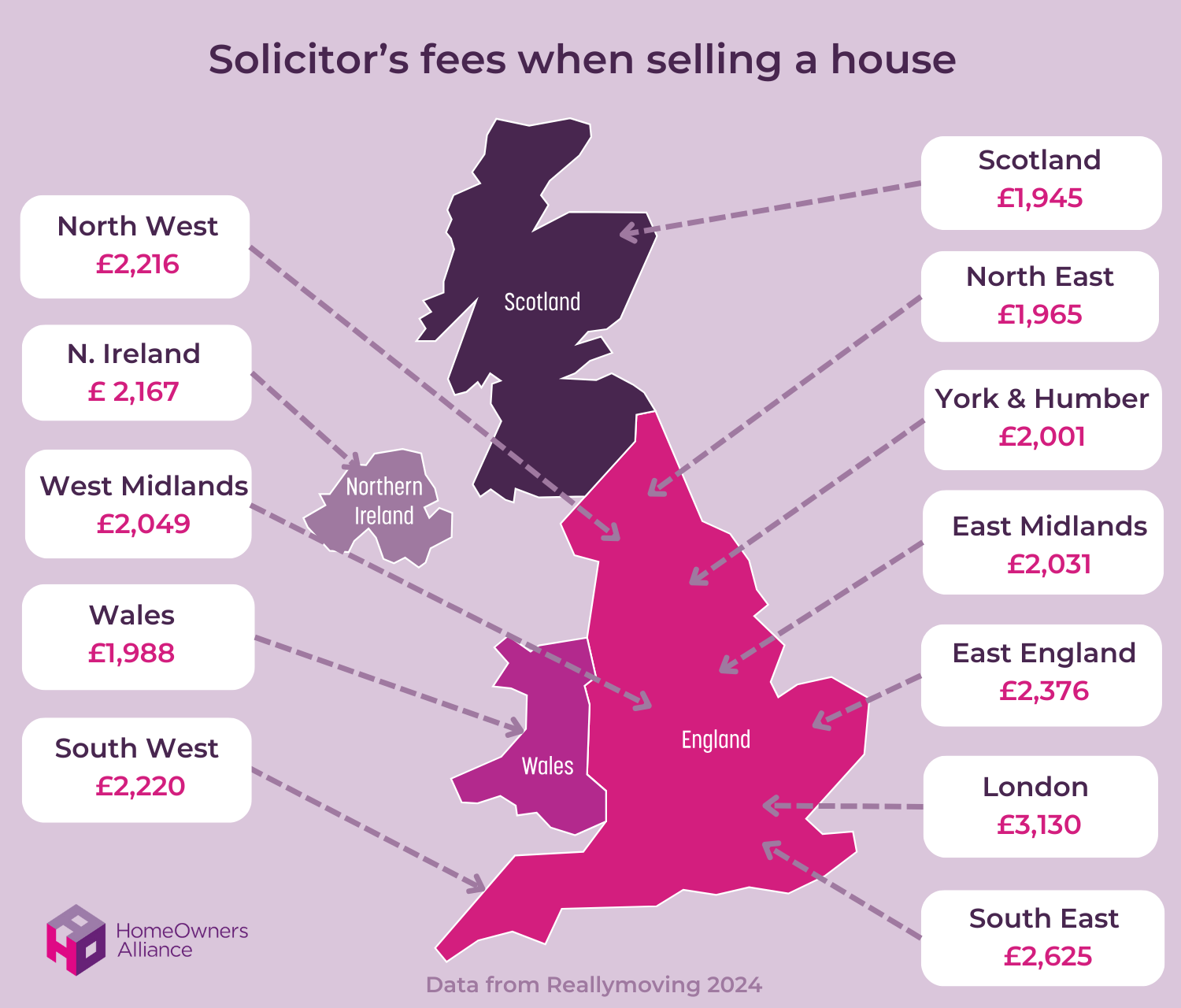
This depends on what you’ve agreed: if you have a no sale, no fee agreement, you won’t need to pay legal fees if the sale falls through. Although you may still need for pay for any disbursements.
However, if you’ve agreed to pay an hourly rate, you’ll need to pay your solicitors’ fees for the work they’ve done even if the sale falls down.
Choosing the right conveyancer or solicitor is key to getting the best service at the best price.
Here are the key qualities to look for in a conveyancing solicitor:
Also, see our guide on important questions to ask your conveyancing solicitor before instructing.
Not legally but the conveyancing process is time-consuming and complex and you shouldn’t consider DIY conveyancing if you don’t fully understand all the steps and the risks involved. Also, if you’re selling a house with a mortgage, the lender will almost certainly insist that you instruct a solicitor. Read more in our guide Can you do your own conveyancing
Yes. The average solicitors’ fees in London are £3,130 and £2,625 in the South East. By comparison, average solicitors’ fees in Scotland are £1,945 and in £1,965 in North East England. For accurate regional pricing use our conveyancing fees calculator.
Solicitors are regulated by the Solicitors Regulation Authority while licensed conveyancers are regulated by the Council for Licensed Conveyancers.
The average solicitors fee for selling a house is £886 including VAT and basic disbursements. But solicitors fees for selling a house can vary widely. Leasehold properties are usually more expensive because additional legal work and management packs are required.
Yes, the seller pays their own solicitor or conveyancer to handle the legal side of the sale.
Licensed conveyancers are often cheaper than solicitors because they specialise exclusively in property transactions.
If you use a ‘no sale no fee’ conveyancer, you won’t usually pay legal fees if the sale falls through, although disbursements may still apply. Read more in our guide No sale no fee conveyancing explained
Leasehold properties require additional legal checks and documentation, including a leasehold management information pack which typically costs £300–£800. Read more in our guide Selling a leasehold property
Technically, doing your own conveyancing, without a solicitor, is possible. But it is strongly discouraged because the legal process is complex and mistakes can lead to delays or financial risk. But if you’re buying or selling with a mortgage, the lender will almost certainly insist that you instruct a conveyancer.
If you are both buying and selling a property, the total solicitor fees are typically between £2,000 and £2,500 including VAT and disbursements, although this can vary depending on property value and complexity.
Typical solicitors fees for selling a house in the UK range from £610 to £950 including VAT and disbursements, depending on the property value, tenure and complexity of the sale.
Conveyancing fees to sell a house include your solicitor’s legal fees plus disbursements such as Land Registry documents, ID checks and leasehold management packs.
HomeOwners Alliance Ltd is registered in England, company number 07861605. Information provided on HomeOwners Alliance is not intended as a recommendation or financial advice.
Mortgage service provided by London & Country Mortgages (L&C), Unit 26 (2.06), Newark Works, 2 Foundry Lane, Bath BA2 3GZ, authorised and regulated by the Financial Conduct Authority (FRN: 143002). The FCA does not regulate most Buy to Let mortgages. Your home or property may be repossessed if you do not keep up repayments on your mortgage.
HomeOwners Alliance Ltd is an Introducer Appointed Representative (IAR) of LifeSearch Limited, an Appointed Representative of LifeSearch Partners Ltd, authorised and regulated by the Financial Conduct Authority. (FRN: 656479).
Independent Financial Adviser service is provided by Unbiased, who match you to a fully regulated, independent financial adviser, with no charge to you for the referral.
Bridging Loan and specialist lending service provided by Chartwell Funding Limited, registered office 5 Badminton Court, Station Road, Yate, Bristol, BS37 5HZ, authorised and regulated by the Financial Conduct Authority (FRN: 458223). Your property may be repossessed if you do not keep up repayments on a mortgage or any debt secured on it.