How to remortgage your home: step-by-step UK guide
Remortgaging usually takes 4-8 weeks and involves switching to a new mortgage deal. People often remortgage to avoid their lender’s standard variable rate (SVR), lower monthly payments, or release equity. This guide explains how the process works and whether remortgaging is right for you.
What is it? Switching your existing mortgage to a new deal, either with your current lender (product transfer) or a new one.
Why remortgage?To avoid your lender’s standard variable rate (SVR), reduce monthly payments, fix your rate, or release equity.
When to start? Start researching 4-6 months before your current deal ends.
How long does it take?Typically 4-8 weeks, but can be longer (around a week for product transfers).
Top tip: Check your loan to value (LTV) first. A lower LTV typically unlocks better rates.
What does remortgaging mean?
Remortgaging is when you switch to another mortgage, or another type of mortgage, such as switching to a buy-to-let mortgage, either with your current mortgage lender or a different one. Your new mortgage will then replace your old one.
When you remortgage, your new lender pays off your existing mortgage and replaces it with a new deal secured against your home. You don’t move property, only the mortgage changes. Once complete, you start making payments under the new rate and terms. The process usually takes 4-8 weeks.
Your mortgage is probably your biggest financial commitment. Your remortgage is as important a decision as when you first got your mortgage and there are lots of different options to choose from. So here we cover what remortgaging entails and what you need to think about.
Your home may be repossessed if you do not keep up repayments on your mortgage. Please note some branches of Mortgage Advice Bureau may charge a fee for mortgage advice if you go direct. The fee is up to 1% but a typical fee is 0.3% of the amount borrowed. So make sure you use this site, this form or phone number for fee-free advice.
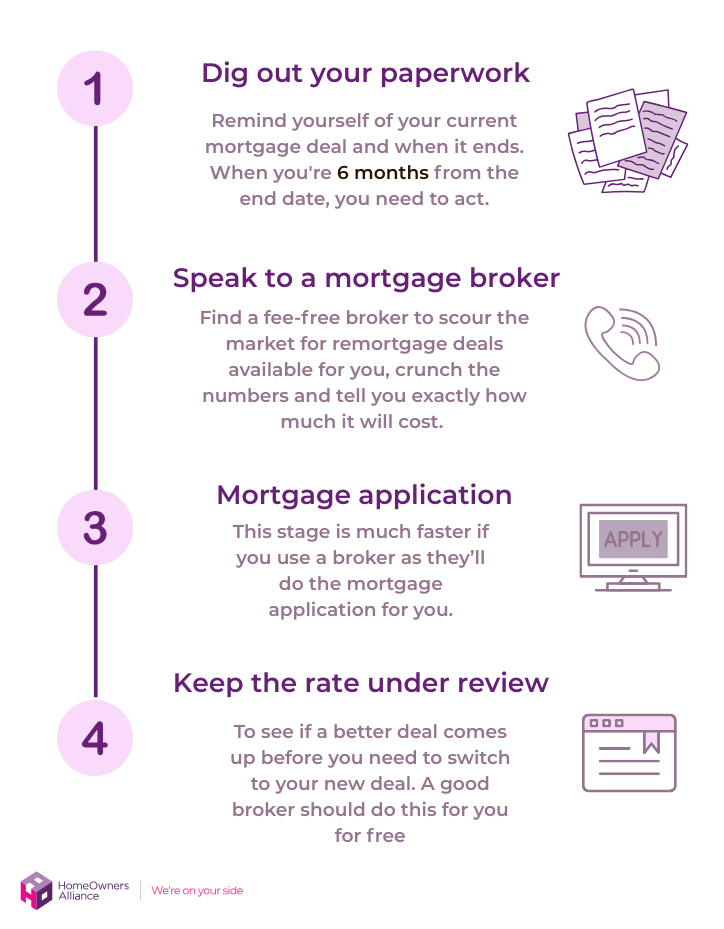
How to remortgage: Step-by-step guide
Here are the steps you’ll need to take to remortgage:
1. Check your current mortgage deal
Dig out your paperwork and remind yourself of the details of your current mortgage. What type of mortgage are you on? What is the current interest rate? How long have you got left to pay? What are your monthly payments?
2. Work out your loan to value (LTV)
You’ll need to calculate your loan to value ratio (LTV), this is the size of your mortgage compared to the value of your home, because this determines which deals you could be able to get. The lower your LTV, the better the mortgage rates you’ll usually have access to.
Your LTV will have improved since you last took out a mortgage if your home’s value has increased and you have a repayment mortgage. This means you may get access to a better range of deals.
4. Decide whether to stay with your lender or switch
You can remortgage with your existing lender (known as a product transfer) or switch to a new lender.
Staying with your current lender is usually quicker and involves less paperwork, however, you may miss out on cheaper rates available at different lenders.
5. Check remortgage costs
If you’re switching lenders, you’ll need a conveyancer to handle the legal work and the lender will usually require a mortgage valuation too. In many cases, legal fees and valuations are included in the remortgage deal.
If you’re remortgaging with your existing lender, legal work and a valuation are usually not required.
Your home may be repossessed if you do not keep up repayments on your mortgage. Please note some branches of Mortgage Advice Bureau may charge a fee for mortgage advice if you go direct. The fee is up to 1% but a typical fee is 0.3% of the amount borrowed. So make sure you use this site, this form or phone number for fee-free advice.
Remortgage Process
Reasons to remortgage
For most people, the main reason for remortgaging is to save money by switching to a new deal when their current one ends, instead of being moved to their lender’s standard variable rate, which can significantly increase monthly payments.
However, there are a number of other reasons why people remortgage:
You want to leave your current mortgage rate to get a better one. However, you’ll need to take into account any fees involved in exiting your current deal like an early repayment charge.
If your circumstances have changed, such as if you’ve inherited some money, and you want to make mortgage overpayments but your current deal won’t let you, or will only let you overpay by a small amount, you may want to remortgage to a more flexible deal.
Moving to a fixed rate deal will give you certainty of your monthly mortgage outgoings. However, while the amount you’ll pay won’t increase in your initial period, it won’t go down either.
Your home may be repossessed if you do not keep up repayments on your mortgage. Please note some branches of Mortgage Advice Bureau may charge a fee for mortgage advice if you go direct. The fee is up to 1% but a typical fee is 0.3% of the amount borrowed. So make sure you use this site, this form or phone number for fee-free advice.
Reasons to not remortgage
However, remortgaging may not be the best option for you, depending on your circumstances.
When remortgaging may not be the right option:
Your mortgage amount is very small.
Your early repayment charge is high.
You have little or no equity in your home. If your property’s value has fallen, a high LTV or negative equity can make it much harder to switch lender.
You’ve had issues with your credit history since applying for your last mortgage.
Set a reminder for around 4-6 months before your current mortgage deal is due to end. This gives you time to secure a new deal and keep it under review in case better rates appear.
If you’re already on your lender’s standard variable rate, you should check your options as soon as possible, as these rates are usually much more expensive than fixed or tracker deals.
Beware of penalties. If you’re in the middle of your current mortgage deal and want to remortgage, it is possible to remortgage early to get a better deal but make sure you find out about any early repayment charges you may need to pay as these can be hefty.
The remortgage process can take up to 3 months, although it can be much quicker.
If you’re remortgaging with your existing lender, known as a product transfer, this generally takes about a week.
If you are remortgaging a leasehold property, be prepared for additional checks, as lenders will review your lease length, ground rent, service charges and buildings insurance. Start preparing for your leasehold remortgage at least six months before your current deal ends to allow time for the extra checks.
The complexity of your mortgage application. For example, if an underwriter asks for more information, this will take extra time.
Problems with your credit report. When you apply to remortgage the lender will check your credit score. So make sure every detail in your credit reports is correct because even a minor spelling mistake on your address could cause a problem.
Missing paperwork. You’ll need to provide various documents like payslips if you’re employed and documents like your SA302 tax calculations if you’re self-employed. So find out what you’ll need to submit in advance and dig them out to avoid delays.
Discrepancies with the property valuation. If there are any discrepancies in the mortgage valuation of the property this could cause delays.
If you’ve changed jobs recently. If you’ve changed jobs in the previous few months, it can make it harder to remortgage, especially if you have become self-employed.
Remortgaging fees: How much will remortgaging cost?
These are the remortgaging costs you may need to pay:
Remortgaging Costs
Typical cost
Early repayment charge
1%-5%, may reduce over the course of your deal.
Exit fee (also known as account fee)
£50 – £300
Arrangement fee
If charged, this is typically £500-£1,500
Legal fees
Lender may include this for free. If not, typical costs are £300+
Mortgage valuation fees
Lender may include this for free. If not, typical costs are £100 – £1500
As you can see from the above table of remortgage costs, there are a number of fees that can apply.
Remortgage fees in detail
Early repayment charge If you’re tied into a deal, it’s likely that you’ll have to pay an early repayment charge if you remortgage before it ends. These are usually calculated as a percentage of the outstanding mortgage balance, typically 1%-5%. Read our guide Early repayment charges and how to avoid them.
Exit fees: Many lenders charge an exit fee for closing your mortgage account, although they may give it a different name.
Arrangement fees: Lenders often charge arrangement fees when you take out a mortgage with them. These vary but generally cost £500-£1,500.
Mortgage valuation fees:Mortgage valuation fees depend on the value of the property and lenders will have their own fee scale. Fees can vary significantly from £100 up to £1500. In many cases a lender will offer a free valuation.
Should I add remortgage fees to my loan?
You can either pay arrangement fees up front when you remortgage or add them to your loan. The latter is a common choice, but interest will be added to the fees and they will end up costing more overall.
What are the barriers to remortgaging?
There are a number of factors that can make it harder to remortgage:
What can make it harder to remortgage and the possible solutions.
Poor credit rating: Issues with your credit history can affect your remortgage chances, but this isn’t always the case and there are ways you can boost your credit rating. Find out more in our guide 11 tips to improve your credit score for a mortgage.
Your age: Lenders have upper limits on when they’ll need your mortgage to be repaid by. However, this upper limit ranges widely. So if this is a concern for you, it’s important to get mortgage advice. Find more information in our guide mortgages for over 50s.
Affordability: Lenders will look at your income and outgoings when considering whether to lend to you or not. If your circumstances have changed for the worse since you last took out a mortgage, you may find it harder to remortgage.
Debt to income ratio: This is the amount of your monthly income used to pay off debts like credit cards, a mortgage and personal loans and is a factor lenders consider when working out whether to lend to you and how much.
If a high proportion of your income goes towards existing debts, this may reduce how much you can borrow or make it harder to remortgage.
Remortgaging can be used in different ways when it comes to Buy to Let property, depending on whether you already own a rental property, are thinking of renting out your home or are looking to invest in one for the first time. These scenarios work differently and usually require specialist advice from a mortgage broker.
Remortgaging a Buy to Let property you already own
If you already own a Buy to Let property, remortgaging can help you save money, or raise funds for property renovations or to expand your portfolio.
If you’re thinking about renting out your home, you may be wondering if switching to a Buy to Let mortgage is possible. Switching to a Buy to Let mortgage means replacing your residential mortgage with a Buy to Let deal so that you can rent out your property. Find out more information including about other potential options in our guide Switching to a Buy to Let mortgage: how it works and your options.
Using your home to fund a Buy to Let purchase
Some people remortgage their own house to release equity and use this money to buy a Buy to Let or holiday home. This can be a quicker way to raise funds but you’ll have two mortgages to manage, plus there’s the risk that both properties could fall in value.
Because your home is being used to support an investment, it’s especially important to understand the risks before going ahead. Read our guide How to invest in property in the UK.
Your home may be repossessed if you do not keep up repayments on your mortgage. Please note some branches of Mortgage Advice Bureau may charge a fee for mortgage advice if you go direct. The fee is up to 1% but a typical fee is 0.3% of the amount borrowed. So make sure you use this site, this form or phone number for fee-free advice.
Can my existing mortgage lender offer the best deal?
The only way to find out if your existing mortgage lender offers the best deal for you is by seeing what other lenders offer. If you speak to a mortgage broker, they’ll compare the best deals for you if you switch to a new lender with what your existing lender is offering you.
However, there are other factors to consider when deciding whether to get a new deal with your existing lender or switching to a new one.
Here are the pros and cons of switching lenders vs staying with your current one
Switching lenders
Staying with current lender
Can you access the best mortgage rates?
Potentially, yes. Although each lender will have its own criteria that you’ll need to meet.
Not necessarily. You’ll be limited to the rates your lender offers
Do you need a mortgage valuation?
Yes. You may need to pay for it
No
Is there legal work involved?
Yes. You may need to pay for it
No
Is there an affordability check?
Yes
Not usually if you’re borrowing the same amount for the same term
There may be some alternatives to remortgaging, depending on your circumstances.
Extending your mortgage term
If you’re having difficulties paying your mortgage you should speak to your lender as soon as possible.
Lenders must treat you fairly and consider any request you make to change the way you pay your mortgage.
So if your payments are unmanageable you can ask about ways to make them more affordable such as by extending the term of your mortgage, taking a payment holiday or accepting lower payments for a while.
If you want to access equity in your house but you don’t want to remortgage because you’ll lose your current mortgage rate or have to pay a high early repayment charge, you may be able to borrow more from your existing lender.
This is called a further advance and this will usually be at a different rate to your main mortgage.
Second charge mortgage
Alternatively, you may choose to take out a second charge mortgage, also known as a homeowner loan. These let you borrow money from a different lender using your house as security. Read more in our guide Homeowner Loans explained.
Frequently Asked Questions
Can I remortgage with my existing lender?
Yes. Remortgaging with your current lender is known as a product transfer. It’s usually quicker and involves less paperwork, as affordability checks and valuations are often not required. However, you may not have access to the best rates available on the wider market.
Do I need a solicitor to remortgage?
If you’re switching lenders, you’ll usually need a solicitor or conveyancer to handle the legal work. Many remortgage deals include free legal services. If you’re staying with your existing lender, legal work is typically not required.
Can I remortgage with bad credit?
It may still be possible to remortgage with bad credit, but your options could be more limited and rates may be higher. Different lenders have different criteria, so it’s worth speaking to a mortgage broker who can advise on lenders most likely to accept your application.
What documents do I need to remortgage?
Common documents include recent payslips or proof of income, bank statements, photo ID, and details of your existing mortgage. If you’re self-employed, you may also need tax calculations or accounts. Having paperwork ready can help avoid delays.
How much does it cost to remortgage?
Remortgaging costs vary but may include arrangement fees, valuation fees, legal fees, exit fees, and early repayment charges. Not all fees apply to every remortgage, and some lenders include certain costs for free.
How does a remortgage work?
A remortgage works by replacing your existing mortgage with a new deal, either with your current lender or a different one. The new lender repays your old mortgage on completion, and you begin making payments under the new rate and terms. The process usually takes 4-8 weeks.
HomeOwners Alliance Ltd is registered in England, company number 07861605. Information provided on HomeOwners
Alliance is not intended as a recommendation or financial advice.
HomeOwners Alliance Ltd is an Introducer Appointed Representative of Mortgage Advice Bureau (Derby) Limited which is authorised and regulated by the Financial Conduct Authority.
If you take out a mortgage or protection product through Mortgage Advice Bureau, they pay us a referral fee of 25%. You are not obliged to use their services.
HomeOwners Alliance Ltd is an Introducer Appointed Representative (IAR) of LifeSearch Limited, an Appointed
Representative of LifeSearch Partners Ltd, authorised and regulated by the Financial Conduct Authority. (FRN:
656479).
Independent Financial Adviser service is provided by Unbiased, who match you to a fully regulated, independent
financial adviser, with no charge to you for the referral.
HomeOwners Alliance Ltd is an Introducer Appointed Representative (IAR) of Fluent Money Limited, which is authorised and regulated by the Financial Conduct Authority. Calls may be monitored/recorded.